Background radiation: Difference between revisions
CSV import |
CSV import |
||
| Line 38: | Line 38: | ||
[[Category:Physics]] | [[Category:Physics]] | ||
{{radiation-stub}} | {{radiation-stub}} | ||
== Background_radiation == | |||
<gallery> | |||
File:Atomic_Testing_Museum_weather_display_cropped.jpg|Atomic Testing Museum weather display | |||
File:Cloud_chambers_played_an_important_role_of_particle_detectors.jpg|Cloud chambers played an important role of particle detectors | |||
File:Sievert-sigle.png|Sievert sigle | |||
File:Kozloduy_Nuclear_Power_Plant_-_Background_radiation_displays.jpg|Kozloduy Nuclear Power Plant - Background radiation displays | |||
File:US_fallout_exposure.png|US fallout exposure | |||
File:Radiocarbon_bomb_spike.svg|Radiocarbon bomb spike | |||
File:G_radiation-level_scale_01.png|G radiation-level scale 01 | |||
</gallery> | |||
Latest revision as of 20:54, 23 February 2025
Background radiation refers to the ionizing radiation present in the environment on Earth at all times. This radiation is emitted from both natural and artificial sources. The natural sources include cosmic rays, terrestrial sources, and internal sources. Artificial sources include nuclear power plants, medical procedures, and consumer products.
Sources of Background Radiation[edit]
Cosmic Rays[edit]
Cosmic rays are high-energy particles originating from outer space that interact with the Earth's atmosphere to create secondary radiation, including X-rays, muons, protons, alpha particles, pions, electrons, and neutrons. The intensity of cosmic rays varies based on altitude and geomagnetic latitude.
Terrestrial Sources[edit]
Terrestrial radiation originates from radioactive materials, such as uranium, thorium, and radon in the ground. The amount of terrestrial radiation varies by location.
Internal Sources[edit]
Internal radiation comes from radioactive substances in the human body. For example, the human body contains small amounts of the radioactive isotopes potassium-40 and carbon-14.
Artificial Sources[edit]
Artificial sources of background radiation include nuclear power plants, medical procedures, and consumer products. For example, coal power plants release trace amounts of radioactive substances into the atmosphere.
Health Effects of Background Radiation[edit]
Background radiation is typically low-level and not harmful to human health. However, prolonged or intense exposure to background radiation can cause health effects such as cancer and genetic damage.
Measurement of Background Radiation[edit]
Background radiation is measured in units of radioactivity (becquerels) or absorbed dose (grays or sieverts). The average annual dose per person from background radiation is about 2-3 millisieverts.
See Also[edit]
This radiation related article is a stub. You can help WikiMD by expanding it.
Background_radiation[edit]
-
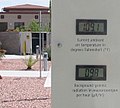 Atomic Testing Museum weather display
 -
 Cloud chambers played an important role of particle detectors
 -
 Sievert sigle
 -
 Kozloduy Nuclear Power Plant - Background radiation displays
 -
 US fallout exposure
 -
 Radiocarbon bomb spike
 -
 G radiation-level scale 01


