Barbed wire: Difference between revisions
CSV import Tags: mobile edit mobile web edit |
CSV import |
||
| Line 33: | Line 33: | ||
{{agriculture-stub}} | {{agriculture-stub}} | ||
{{military-stub}} | {{military-stub}} | ||
== Barbed wire == | |||
<gallery> | |||
File:Rusted_barbed_wire.jpg|Rusted barbed wire | |||
File:Historicbarbedwire.jpg|Historic barbed wire | |||
File:Auschwitz_II_Birkenau.jpg|Auschwitz II Birkenau | |||
</gallery> | |||
Latest revision as of 00:59, 27 February 2025
Barbed wire, also known as barb wire, is a type of steel fencing wire constructed with sharp edges or points arranged at intervals along the strand(s). It is used to construct inexpensive fences and is used atop walls surrounding secured property. It is also a major feature of the fortifications in trench warfare (a type of combat in which opposing troops fight from trenches facing each other).
History[edit]
Barbed wire was first patented in the United States in 1867 by Lucien B. Smith of Kent, Ohio, who is regarded as the inventor. Joseph F. Glidden of DeKalb, Illinois, received a patent for the modern invention in 1874 after he made his own modifications to previous versions.
Design[edit]
Barbed wire is characterized by a wire with fixed barbs. Barbs are typically spaced four to five inches apart. A person or animal trying to pass through or over barbed wire will suffer discomfort and possibly injury. Barbed wire fencing requires only fence posts, wire, and fixing devices such as staples. It is simple to construct and quick to erect, even by an unskilled person.
Uses[edit]
Barbed wire is extensively used for fencing in the agriculture industry to prevent livestock from straying onto farmland where they could damage crops. In areas where fencing is frequently cut or damaged, barbed wire is an inexpensive way to secure a boundary.
Barbed wire has also been widely used in military settings. During the World War I, it was used extensively to form defensive wire obstacles, ranging from massive, complex designs to simple unmarked wires stretched across the ground.
Impact[edit]
The introduction of barbed wire contributed to the range wars of the American West, as various factions fought for control of the open range. For the first time, it was possible to keep cattle contained without the need for large numbers of range riders.
See also[edit]
References[edit]
<references />

This article is a agriculture stub. You can help WikiMD by expanding it!

Barbed wire[edit]
-
 Rusted barbed wire
 -
 Historic barbed wire
 -
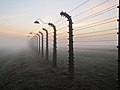 Auschwitz II Birkenau


