Back brace: Difference between revisions
CSV import Tags: mobile edit mobile web edit |
CSV import |
||
| Line 24: | Line 24: | ||
[[Category:Orthopedic braces]] | [[Category:Orthopedic braces]] | ||
{{medical device-stub}} | {{medical device-stub}} | ||
== Back brace == | |||
<gallery> | |||
File:Teenage girls back brace - front.jpg|Teenage girl's back brace - front | |||
File:Full shell back brace - fitted to female adolescent.jpg|Full shell back brace - fitted to female adolescent | |||
File:Milwaukee brace - with neck ring and mandible pad.jpg|Milwaukee brace - with neck ring and mandible pad | |||
File:Full TLSO orthopedic back brace.jpg|Full TLSO orthopedic back brace | |||
File:Full rigid shell back brace - fitted to female adolescent 23 hours daily.jpg|Full rigid shell back brace - fitted to female adolescent 23 hours daily | |||
File:Hyperextension body brace fitted to adolescent female patient in body suit 3.jpg|Hyperextension body brace fitted to adolescent female patient in body suit | |||
</gallery> | |||
Latest revision as of 01:16, 20 February 2025
Back brace is a device designed to limit the motion of the spine in cases of fracture or in post-operative fusions, as well as a preventative measure against some progressive conditions.
Common Uses[edit]
Back braces are commonly prescribed to treat a variety of conditions. These include spinal fracture, scoliosis, back pain, post-operative spinal fusion, and as a preventative measure for progressive conditions such as osteoporosis.
Types of Back Braces[edit]
There are two main types of back braces: soft and rigid. Soft back braces are used for less serious conditions such as lower back pain, while rigid back braces are used for more serious conditions such as spinal fractures.
Soft Back Braces[edit]
Soft back braces are typically made from a combination of elastic cotton and nylon. They are used to compress the abdominal muscles and support the spine.
Rigid Back Braces[edit]
Rigid back braces are made from hard plastic and are used to restrict up to 50% of the spine's movement. They are typically used in the treatment of more serious conditions such as spinal fractures.
Risks and Complications[edit]
While back braces can be an effective treatment for a variety of conditions, they are not without risks. Potential complications include skin irritation, muscle atrophy, and dependence on the brace for support.
See Also[edit]
This medical device related article is a stub. You can help WikiMD by expanding it.
Back brace[edit]
-
 Teenage girl's back brace - front
 -
 Full shell back brace - fitted to female adolescent
 -
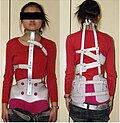 Milwaukee brace - with neck ring and mandible pad
 -
 Full TLSO orthopedic back brace
 -
 Full rigid shell back brace - fitted to female adolescent 23 hours daily
 -
 Hyperextension body brace fitted to adolescent female patient in body suit


