Beam splitter: Difference between revisions
CSV import Tags: mobile edit mobile web edit |
CSV import |
||
| Line 44: | Line 44: | ||
{{Engineering-stub}} | {{Engineering-stub}} | ||
{{Telecommunications-stub}} | {{Telecommunications-stub}} | ||
== Beam splitter gallery == | |||
<gallery> | |||
File:Beam-splitter.svg|Beam-splitter | |||
File:Beamsplitter-2.jpg|Beamsplitter-2 | |||
File:Flat metal-coated beamsplitter.png|Flat metal-coated beamsplitter | |||
File:Wavesplitter1.GIF|Wavesplitter1 | |||
File:InfraTec Beamsplitter Prinzip.jpg|InfraTec Beamsplitter Prinzip | |||
</gallery> | |||
Latest revision as of 05:19, 3 March 2025
Beam Splitter
A beam splitter is an optical device that splits a beam of light in two. It is one of the key components of the interferometer used in the interferometric gravitational wave detectors.
Function[edit]
The main function of a beam splitter is to split a single beam of light into two separate beams. This is achieved by using a material that has a 50% chance of transmitting the light and a 50% chance of reflecting it. The beam splitter is usually made of glass or other transparent materials, and is often coated with a thin layer of metal or dielectric material to enhance its reflective properties.
Types of Beam Splitters[edit]
There are several types of beam splitters, each with its own unique properties and applications. These include:
- Polarizing Beam Splitters: These beam splitters use polarization to split the beam of light. They are often used in applications where the polarization state of the light is important, such as in quantum optics and optical communication systems.
- Non-Polarizing Beam Splitters: These beam splitters do not affect the polarization state of the light. They are often used in applications where the polarization state of the light is not important, such as in laser systems and optical microscopy.
- Dichroic Beam Splitters: These beam splitters use the wavelength of the light to split the beam. They are often used in applications where the wavelength of the light is important, such as in fluorescence microscopy and spectroscopy.
Applications[edit]
Beam splitters have a wide range of applications in various fields, including physics, engineering, medicine, and telecommunications. Some of the most common applications include:
- Interferometry: Beam splitters are a key component of interferometers, which are used to measure small displacements, refractive index changes, and surface irregularities.
- Laser Systems: Beam splitters are used in laser systems to split the laser beam into two or more beams, which can then be used for different purposes.
- Optical Microscopy: Beam splitters are used in optical microscopy to split the light beam into two, allowing for simultaneous observation and imaging of the sample.
- Telecommunications: Beam splitters are used in optical communication systems to split the light signal into multiple paths, allowing for simultaneous transmission and reception of data.
See Also[edit]


Beam splitter gallery[edit]
-
 Beam-splitter
 -
 Beamsplitter-2
 -
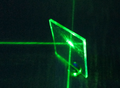 Flat metal-coated beamsplitter
 -
 Wavesplitter1
 -
 InfraTec Beamsplitter Prinzip


