Berberis canadensis: Difference between revisions
CSV import Tags: mobile edit mobile web edit |
CSV import |
||
| Line 23: | Line 23: | ||
{{Flora-stub}} | {{Flora-stub}} | ||
{{Medicine-stub}} | {{Medicine-stub}} | ||
<gallery> | |||
File:Berberis_canadiensis_RB.jpg|Berberis canadiensis RB | |||
File:B._canadensis.jpg|B. canadensis | |||
File:Berberis_canadensis.png|Berberis canadensis | |||
</gallery> | |||
Latest revision as of 21:18, 23 February 2025
Berberis canadensis, commonly known as American barberry or Canadian barberry, is a species of plant in the Berberidaceae family. It is native to the eastern United States and is particularly prevalent in the Appalachian Mountains.
Description[edit]
Berberis canadensis is a deciduous shrub that typically grows to a height of 1–2 meters. The leaves are arranged in clusters, each leaf being 2–5 cm long. The flowers are yellow, 3–6 mm in diameter, and bloom in late spring. The fruit is a red berry, 5–10 mm in diameter, which ripens in late summer or early fall.
Distribution and habitat[edit]
Berberis canadensis is found in the eastern United States, particularly in the Appalachian Mountains. It grows in a variety of habitats, including forests, grasslands, and wetlands. It prefers well-drained, acidic soils and can tolerate both full sun and partial shade.
Uses[edit]
The berries of Berberis canadensis have been used by Native Americans for medicinal purposes. They contain berberine, a compound with antimicrobial, anti-inflammatory, and antioxidant properties. The plant has also been used in traditional Chinese medicine.
Conservation status[edit]
Berberis canadensis is considered endangered in several states in the United States due to habitat loss and overharvesting. Conservation efforts are underway to protect and restore populations of this species.
See also[edit]

This flora-related article is a stub. You can help WikiMD by expanding it.

-
 Berberis canadiensis RB
 -
 B. canadensis
 -
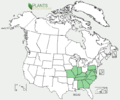 Berberis canadensis


