Aromatic compound: Difference between revisions
CSV import Tags: mobile edit mobile web edit |
CSV import |
||
| Line 1: | Line 1: | ||
== Apple II == | |||
The '''Apple II''' is an 8-bit home computer, one of the first highly successful mass-produced microcomputer products, designed primarily by [[Steve Wozniak]]. It was introduced in 1977 by [[Apple Computer, Inc.]] (now [[Apple Inc.]]). The Apple II series was the first consumer product sold by Apple and was a major factor in the company's early success. | |||
The | === History === | ||
The Apple II was launched in April 1977, following the success of the [[Apple I]], which was a limited production model. The Apple II was designed to be a complete, ready-to-use computer, unlike its predecessor, which was sold as a kit. It featured a plastic case, a keyboard, and the ability to display color graphics, which was a significant advancement at the time. | |||
== | === Design and Features === | ||
The Apple II was notable for its use of the [[MOS Technology 6502]] microprocessor running at 1 MHz, and it came with 4 KB of RAM, expandable to 48 KB. It had a built-in [[BASIC]] programming language interpreter, which allowed users to write their own programs. The computer also supported a variety of peripherals, including a [[floppy disk]] drive, which was introduced in 1978 as the [[Disk II]]. | |||
The Apple II's design included eight expansion slots, which allowed users to add additional hardware capabilities, such as more memory, better graphics, or networking capabilities. This expandability was one of the key factors in the Apple II's success, as it allowed the computer to grow with the user's needs. | |||
The | === Models === | ||
The Apple II series included several models: | |||
* '''Apple II Plus''': Released in 1979, it featured more memory and an updated version of BASIC. | |||
* '''Apple IIe''': Introduced in 1983, it was the most popular model, with improved features and expandability. | |||
* '''Apple IIc''': A compact version released in 1984, designed for portability. | |||
* '''Apple IIGS''': Launched in 1986, it offered enhanced graphics and sound capabilities, and was the most powerful model in the series. | |||
=== Impact and Legacy === | |||
The Apple II was instrumental in establishing the personal computer market. It was widely used in education, business, and at home. The availability of software, such as [[VisiCalc]], the first spreadsheet program, made the Apple II a valuable tool for business users. | |||
The Apple II series continued to be produced until 1993, with over 5 million units sold. Its success helped Apple become a major player in the computer industry and laid the groundwork for future innovations. | |||
== Related Pages == | |||
* [[Apple I]] | |||
* [[Apple III]] | |||
* [[Apple Lisa]] | |||
* [[Macintosh]] | |||
== | == Gallery == | ||
<gallery> | |||
File:Apple2Logo.svg|Apple II Logo | |||
File:Apple_II-IMG_7064.jpg|Apple II | |||
File:Apple_iie.jpg|Apple IIe | |||
File:Apple_IIc_with_monitor.jpg|Apple IIc with monitor | |||
File:Apple_Museum_(Prague)_Apple_IIGS_Woz_(1986).jpg|Apple IIGS | |||
File:Micromodem_II_in_Apple_II.jpg|Micromodem II in Apple II | |||
File:Apple_II_Plus.jpg|Apple II Plus | |||
File:Apple_II_plus.jpg|Apple II Plus | |||
File:Apple_II_J-Plus.jpg|Apple II J-Plus | |||
File:Apple_iicb.jpg|Apple IIc | |||
File:Apple_IIGS_with_peripherals.jpg|Apple IIGS with peripherals | |||
File:Apple_IIc_Plus_(front).jpg|Apple IIc Plus | |||
File:Apple_II_advertisement_Dec_1977_page_1.jpg|Apple II advertisement, December 1977 | |||
File:Apple_II_Europlus_Tietokonemuseo.JPG|Apple II Europlus | |||
</gallery> | |||
[[Category:Apple II]] | |||
[[Category:Apple Inc. hardware]] | |||
[[Category:Home computers]] | |||
[[Category: | |||
[[Category: | |||
Revision as of 18:50, 11 February 2025
Apple II
The Apple II is an 8-bit home computer, one of the first highly successful mass-produced microcomputer products, designed primarily by Steve Wozniak. It was introduced in 1977 by Apple Computer, Inc. (now Apple Inc.). The Apple II series was the first consumer product sold by Apple and was a major factor in the company's early success.
History
The Apple II was launched in April 1977, following the success of the Apple I, which was a limited production model. The Apple II was designed to be a complete, ready-to-use computer, unlike its predecessor, which was sold as a kit. It featured a plastic case, a keyboard, and the ability to display color graphics, which was a significant advancement at the time.
Design and Features
The Apple II was notable for its use of the MOS Technology 6502 microprocessor running at 1 MHz, and it came with 4 KB of RAM, expandable to 48 KB. It had a built-in BASIC programming language interpreter, which allowed users to write their own programs. The computer also supported a variety of peripherals, including a floppy disk drive, which was introduced in 1978 as the Disk II.
The Apple II's design included eight expansion slots, which allowed users to add additional hardware capabilities, such as more memory, better graphics, or networking capabilities. This expandability was one of the key factors in the Apple II's success, as it allowed the computer to grow with the user's needs.
Models
The Apple II series included several models:
- Apple II Plus: Released in 1979, it featured more memory and an updated version of BASIC.
- Apple IIe: Introduced in 1983, it was the most popular model, with improved features and expandability.
- Apple IIc: A compact version released in 1984, designed for portability.
- Apple IIGS: Launched in 1986, it offered enhanced graphics and sound capabilities, and was the most powerful model in the series.
Impact and Legacy
The Apple II was instrumental in establishing the personal computer market. It was widely used in education, business, and at home. The availability of software, such as VisiCalc, the first spreadsheet program, made the Apple II a valuable tool for business users.
The Apple II series continued to be produced until 1993, with over 5 million units sold. Its success helped Apple become a major player in the computer industry and laid the groundwork for future innovations.
Related Pages
Gallery
-
 Apple II Logo
 -
 Apple II
 -
 Apple IIe
 -
 Apple IIc with monitor
 -
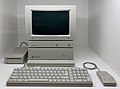 Apple IIGS
 -
 Micromodem II in Apple II
 -
 Apple II Plus
 -
 Apple II Plus
 -
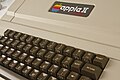 Apple II J-Plus
 -
 Apple IIc
 -
 Apple IIGS with peripherals
 -
 Apple IIc Plus
 -
 Apple II advertisement, December 1977
 -
 Apple II Europlus


_Apple_IIGS_Woz_(1986).jpg)


.jpg)


