Atlantic cod: Difference between revisions
CSV import Tags: mobile edit mobile web edit |
CSV import |
||
| Line 32: | Line 32: | ||
[[Category:Vulnerable animals]] | [[Category:Vulnerable animals]] | ||
{{Fish-stub}} | {{Fish-stub}} | ||
<gallery> | |||
File:Atlantic_Cod,_Atlantischer_Kabeljau_(Gadus_morhua).jpg|Atlantic Cod, Atlantischer Kabeljau (Gadus morhua) | |||
File:Atlantic_cod.jpg|Atlantic cod | |||
File:Atlantic_cod_under_a_shipwreck.jpg|Atlantic cod under a shipwreck | |||
File:Jonge_kabeljauwen_oftewel_gul_rondom_een_wrak_met_andere_vissen-4885742.webm|Jonge kabeljauwen oftewel gul rondom een wrak met andere vissen | |||
File:Kabeljauwen_houden_zich_op_bij_een_wrak_en_bevrijden_zichzelf-4885741.webm|Kabeljauwen houden zich op bij een wrak en bevrijden zichzelf | |||
File:Gadus_morhua_(High_Arctic,_Canada).png|Gadus morhua (High Arctic, Canada) | |||
File:Gravid_female_cod.jpg|Gravid female cod | |||
File:Jonge_kabeljauwen_of_gul_nieuwsgierig_bij_een_wrak-4885743.webm|Jonge kabeljauwen of gul nieuwsgierig bij een wrak | |||
File:Gadus_morhua_(head).jpg|Gadus morhua (head) | |||
File:Gadus_morhua_Cod-2b-Atlanterhavsparken-Norway.JPG|Gadus morhua Cod-2b Atlanterhavsparken Norway | |||
File:Atlantic_cod,_capture_production,_million_tonnes,_1950-2022.svg|Atlantic cod, capture production, million tonnes, 1950-2022 | |||
File:Atlantic_cod_landings_western_Atlantic.jpg|Atlantic cod landings western Atlantic | |||
</gallery> | |||
Latest revision as of 21:06, 23 February 2025
Atlantic cod (Gadus morhua) is a benthopelagic fish of the family Gadidae, widely consumed by humans. It is also commercially known as cod or codling. Dry cod may be prepared as unsalted stockfish, as cured salt cod or clipfish.
In the western Atlantic Ocean, cod has a distribution north of Cape Hatteras, North Carolina, and around both coasts of Greenland and the Labrador Sea; in the eastern Atlantic, it is found from the Bay of Biscay north to the Arctic Ocean, including the Baltic Sea, the North Sea, Sea of the Hebrides, areas around Iceland and the Barents Sea.
Biology[edit]
The Atlantic cod is a medium to large saltwater fish: generally averaging two to three kilograms in weight and about 40 to 80 centimetres in length, the largest recorded specimen was 6 feet (1.8 m) long and weighed 211 lb (96 kg). It can change colour at certain water depths, and has two distinct colour phases: gray-green and reddish brown. Its habitat ranges from the shoreline down to the continental shelf.
Several cod stocks collapsed in the 1990s (declined by >95% of maximum historical biomass) due to overfishing and temperature changes. With the climate warming, it is expected to migrate further north.
Commercial use[edit]
Atlantic cod have been heavily exploited commercially throughout history and are considered as vital economic commodities in several countries. Overfishing has led to a large decline in the population. This has led to many regulatory measures and changes in fishing techniques over the years.
Cod form a significant part of the diet of many cultures, and have been salted and dried for preservation for centuries. The flesh is dense and flaky, and renowned for its culinary versatility.
Conservation status[edit]
The Atlantic cod has been classified as Vulnerable on the IUCN Red List of Threatened Species. It is a candidate for listing under the US Endangered Species Act.
See also[edit]
References[edit]
<references />
-
 Atlantic Cod, Atlantischer Kabeljau (Gadus morhua)
 -
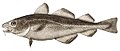 Atlantic cod
 -
 Atlantic cod under a shipwreck
 -
 Jonge kabeljauwen oftewel gul rondom een wrak met andere vissen
 -
Kabeljauwen houden zich op bij een wrak en bevrijden zichzelf
-
 Gadus morhua (High Arctic, Canada)
 -
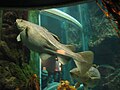 Gravid female cod
 -
Jonge kabeljauwen of gul nieuwsgierig bij een wrak
-
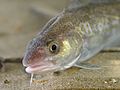 Gadus morhua (head)
 -
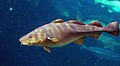 Gadus morhua Cod-2b Atlanterhavsparken Norway
 -
 Atlantic cod, capture production, million tonnes, 1950-2022
 -
 Atlantic cod landings western Atlantic
.jpg)


.png)

.jpg)


