Rhizoxin: Difference between revisions
CSV import |
CSV import |
||
| Line 25: | Line 25: | ||
{{Chem-stub}} | {{Chem-stub}} | ||
{{medicine-stub}} | {{medicine-stub}} | ||
== Rhizoxin == | |||
<gallery> | |||
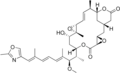
File:Rhizoxin.png|Rhizoxin | |||
</gallery> | |||
Latest revision as of 21:10, 23 February 2025
Rhizoxin is a macrocyclic lactone with antimitotic properties, originally isolated from the fungus Rhizopus microsporus. It is a potent inhibitor of microtubule dynamics, disrupting the mitotic spindle and preventing cell division. Rhizoxin has been studied for its potential use in cancer therapy due to its ability to halt the proliferation of cancer cells.
History[edit]
Rhizoxin was first isolated in 1984 from the fungus Rhizopus microsporus by researchers at the University of Tokyo. The compound was found to have potent antimitotic properties, leading to interest in its potential use as a cancer therapeutic.
Structure and Mechanism of Action[edit]
Rhizoxin is a macrocyclic lactone, a class of compounds known for their complex structures and diverse biological activities. It binds to the β-subunit of tubulin, a protein that forms the microtubules of the mitotic spindle. This binding disrupts the dynamic instability of microtubules, preventing their assembly and disassembly. As a result, the mitotic spindle cannot form properly, and cell division is halted.
Therapeutic Potential[edit]
Due to its potent antimitotic properties, rhizoxin has been studied for its potential use in cancer therapy. It has been shown to be effective against a range of cancer cell types in vitro, including breast cancer, lung cancer, and colorectal cancer cells. However, its use in humans has been limited by its toxicity and the development of resistance.
See Also[edit]


Rhizoxin[edit]
-
 Rhizoxin

