Rehearsal: Difference between revisions
CSV import Tags: mobile edit mobile web edit |
CSV import |
||
| Line 42: | Line 42: | ||
{{Performing arts}} | {{Performing arts}} | ||
{{Theatre-stub}} | {{Theatre-stub}} | ||
<gallery> | |||
File:Marco Ricci - Rehearsal of an opera - Google Art Project (2328395) retuschiert.jpg|Rehearsal | |||
File:Alabino05042017-02.jpg|Rehearsal | |||
File:Laura Liguori playing Lilya Brik, production rehearsal of "Mayakovsky and Stalin".jpg|Rehearsal | |||
File:Jack Benny rehearsal.jpg|Rehearsal | |||
File:Steamcog Rehearsal Sept 2019 01.jpg|Rehearsal | |||
</gallery> | |||
Latest revision as of 01:45, 20 February 2025
Rehearsal is a process that involves the repetition of activities in the pursuit of mastery and fluency. In the context of performing arts, a rehearsal is a structured process in which performers and directors work together to prepare for a public presentation.
Overview[edit]
Rehearsals are used in a variety of disciplines, including theatre, music, dance, film, and television. They are essential for refining the technical aspects of a performance, such as timing, pacing, and coordination, as well as developing the emotional nuances of characters and narratives.
Types of Rehearsals[edit]
There are several types of rehearsals, each with a specific purpose and structure.
Table Read[edit]
A Table read is an initial rehearsal where the cast reads through the script together. This allows everyone to understand the overall story and their characters' roles within it.
Blocking Rehearsal[edit]
In a blocking rehearsal, the director and performers work out the physical movement and positioning on stage.
Technical Rehearsal[edit]
A Technical rehearsal involves the technical aspects of a production, such as lighting, sound, and set changes.
Dress Rehearsal[edit]
A Dress rehearsal is a full run-through of the performance in costume and with all technical elements in place. It is often the final rehearsal before a performance opens to the public.
Benefits of Rehearsal[edit]
Rehearsal allows performers to practice and refine their performances, and it provides an opportunity for the director to shape the production. It also helps to build confidence, as performers become more familiar with their roles and the production as a whole.
See Also[edit]
| Part of a series on |
| Performing arts |
|---|

-
 Rehearsal
 -
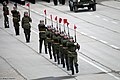 Rehearsal
 -
 Rehearsal
 -
 Rehearsal
 -
 Rehearsal
_retuschiert.jpg)


