Sebaceous hyperplasia: Difference between revisions
CSV import |
CSV import |
||
| Line 26: | Line 26: | ||
[[Category:Age-related diseases]] | [[Category:Age-related diseases]] | ||
{{Dermatology-stub}} | {{Dermatology-stub}} | ||
== Sebaceous hyperplasia == | |||
<gallery> | |||
File:Sebaceous hyperplasia.jpg|Sebaceous hyperplasia | |||
File:Photography of sebaceous hyperplasia.jpg|Photography of sebaceous hyperplasia | |||
File:Dermoscopy of sebaceous hyperplasia.jpg|Dermoscopy of sebaceous hyperplasia | |||
File:High dynamic range dermoscopy of sebaceous hyperplasia.jpg|High dynamic range dermoscopy of sebaceous hyperplasia | |||
File:Histopathology of sebaceous hyperplasia.jpg|Histopathology of sebaceous hyperplasia | |||
File:Malignant Melanoma right temple medial adjacent sebaceous hyperplasia right temple lateral.jpg|Malignant Melanoma right temple medial adjacent sebaceous hyperplasia right temple lateral | |||
File:Sebaceaous Hyperplasia Chronic folliculits Right Mid Chest.jpg|Sebaceous Hyperplasia Chronic folliculitis Right Mid Chest | |||
</gallery> | |||
Revision as of 01:24, 20 February 2025
Sebaceous Hyperplasia is a benign condition of the sebaceous glands, characterized by small, soft, yellowish papules on the skin. These papules are typically 1-5mm in diameter and are often found on the forehead, cheeks, and nose.
Causes
Sebaceous hyperplasia is primarily caused by the aging process. As individuals age, their sebaceous glands can become enlarged, leading to the formation of these papules. Other factors that may contribute to the development of sebaceous hyperplasia include sun exposure, a history of skin damage, and certain genetic predispositions.
Symptoms
The primary symptom of sebaceous hyperplasia is the presence of small, yellowish papules on the skin. These papules are typically painless and do not cause any discomfort. However, they can be cosmetically concerning for some individuals.
Diagnosis
Sebaceous hyperplasia is typically diagnosed through a physical examination of the skin. In some cases, a biopsy may be performed to rule out other conditions, such as basal cell carcinoma.
Treatment
Treatment for sebaceous hyperplasia typically involves procedures to remove or reduce the appearance of the papules. These may include cryotherapy, electrocautery, laser therapy, or topical treatments. However, these treatments may not prevent new papules from forming.
Prevention
While sebaceous hyperplasia cannot be completely prevented, individuals can take steps to reduce their risk. This includes protecting the skin from sun damage, maintaining a healthy diet, and using non-comedogenic skincare products.
See Also
This article is a dermatology stub. You can help WikiMD by expanding it!
Sebaceous hyperplasia
-
 Sebaceous hyperplasia
 -
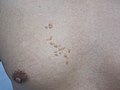 Photography of sebaceous hyperplasia
 -
 Dermoscopy of sebaceous hyperplasia
 -
High dynamic range dermoscopy of sebaceous hyperplasia
-
Histopathology of sebaceous hyperplasia
-
Malignant Melanoma right temple medial adjacent sebaceous hyperplasia right temple lateral
-
Sebaceous Hyperplasia Chronic folliculitis Right Mid Chest


