Propane: Difference between revisions
CSV import Tags: mobile edit mobile web edit |
CSV import |
||
| Line 31: | Line 31: | ||
{{Chemistry-stub}} | {{Chemistry-stub}} | ||
{{Energy-stub}} | {{Energy-stub}} | ||
<gallery> | |||
File:Propane_tank_20lb.jpg|20 lb Propane Tank | |||
File:Propane_flame_contours-en.svg|Propane Flame Contours | |||
File:Propane_butane_liquid_vapor_density_zivenko.png|Propane and Butane Liquid Vapor Density | |||
File:150_gallon_Propane_Tank.jpg|150 Gallon Propane Tank | |||
File:Propane_cylinders_type_2012_and_2000_in_Tuntorp.jpg|Propane Cylinders Type 2012 and 2000 in Tuntorp | |||
</gallery> | |||
Latest revision as of 04:27, 18 February 2025
Propane is a hydrocarbon (specifically, an alkane) with the molecular formula C3H8. It is a gas at standard temperature and pressure, but can be liquefied through pressurization. Propane is commonly used as a fuel for engines, oxy-gas torches, barbecues, portable stoves, and residential central heating.
History[edit]
Dr. Walter Snelling of the U.S. Bureau of Mines first identified propane in 1910. He discovered that the volatile component in gasoline was a gas which could be used for light and heat. The first commercial propane gas was sold in 1912.
Properties and reactions[edit]
Propane is a three-carbon alkane, normally a gas, but compressible to a transportable liquid. It is derived from other petroleum products during oil or natural gas processing. It is commonly used as a fuel for engines, oxy-gas torches, barbecues, portable stoves, and residential central heating.
Uses[edit]
Propane is used in a variety of applications. These include heating, cooking, and as a fuel for internal combustion engines. It is also used in the production of petrochemicals.
Safety[edit]
Propane is a safe and efficient energy source, but like all fuels, it must be handled properly. Propane is heavier than air, so it can accumulate in low-lying areas and can ignite if it comes into contact with a source of ignition.
Environmental impact[edit]
Propane is one of the cleanest burning of all fossil fuels. It emits less than half the greenhouse gas emissions of coal to produce the same amount of energy, while also producing fewer toxins and pollutants.
See also[edit]
References[edit]
<references />


-
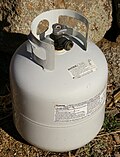 20 lb Propane Tank
 -
 Propane Flame Contours
 -
 Propane and Butane Liquid Vapor Density
 -
 150 Gallon Propane Tank
 -
 Propane Cylinders Type 2012 and 2000 in Tuntorp


