Rigatoni: Difference between revisions
CSV import |
CSV import |
||
| Line 21: | Line 21: | ||
[[Category:Italian cuisine]] | [[Category:Italian cuisine]] | ||
{{food-stub}} | {{food-stub}} | ||
<gallery> | |||
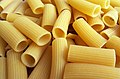
File:Rigatoni.jpg|Rigatoni | |||
</gallery> | |||
Latest revision as of 01:23, 20 February 2025
Rigatoni is a form of pasta originating from Italy. It is a popular choice in Italian cuisine, particularly in the southern regions of the country. Rigatoni is characterized by its tube-like shape, ridged texture, and ability to hold sauces well due to its hollow interior.
History[edit]
The exact origins of rigatoni are unclear, but it is believed to have been developed in southern Italy. The name "rigatoni" comes from the Italian word "rigati", which means "ridged" or "lined", and is a reference to the pasta's distinctive texture.
Characteristics[edit]
Rigatoni is a tube-shaped pasta, similar in shape to penne, but larger and with straight ends. It is typically about 1.5 inches in length, with a diameter of about 0.6 inches. The pasta's ridged surface is ideal for holding onto robust and hearty sauces, making it a popular choice for a variety of Italian dishes.
Culinary Uses[edit]
Rigatoni is versatile and can be used in a variety of dishes. It is often served with chunky meat or vegetable sauces, as the large tubes can hold onto the ingredients well. Rigatoni is also commonly used in baked pasta dishes, such as Rigatoni al forno, where it is mixed with sauce and cheese and then baked until golden and bubbly.
Production[edit]
Rigatoni is made from durum wheat, a hard variety of wheat that is high in protein and gluten. The dough is extruded through a die to create the tube shape, and then cut into the characteristic short lengths. The ridges on the pasta are created by the extrusion process.
See Also[edit]

-
 Rigatoni

