Human genetics: Difference between revisions
CSV import |
CSV import |
||
| Line 44: | Line 44: | ||
[[Category:Human genetics]] | [[Category:Human genetics]] | ||
{{Genetics-stub}} | {{Genetics-stub}} | ||
<gallery> | |||
File:Autosomal_Recessive_Pedigree_Chart.svg|Autosomal Recessive Pedigree Chart | |||
File:Human_male_karyotype.gif|Human Male Karyotype | |||
File:A_region_in_the_pseudoautosomal_region_of_the_short_arms_of_the_X-_and_Y-chromosome.jpg|A region in the pseudoautosomal region of the short arms of the X- and Y-chromosome | |||
</gallery> | |||
Latest revision as of 04:13, 18 February 2025
Human genetics is the study of inheritance as it occurs in human beings. Human genetics encompasses a variety of overlapping fields including: classical genetics, cytogenetics, molecular genetics, biochemical genetics, genomics, population genetics, developmental genetics, clinical genetics, and genetic counseling.
Overview[edit]
Human genetics is a multifaceted field that involves the study of the human genome, the complete set of human genetic material contained in our DNA. This includes the study of genes, which are the basic units of heredity, as well as the study of chromosomes, the structures that house our genes.
Classical Genetics[edit]
Classical genetics is the branch of genetics that studies the way traits are passed from parents to offspring. This field was founded on the work of Gregor Mendel, who is often called the "father of genetics". Mendel's work established the basic laws of inheritance, which are still used today to predict the outcomes of genetic crosses.
Cytogenetics[edit]
Cytogenetics is the branch of genetics that studies the structure and function of the cell, especially the chromosomes. It includes routine analysis of G-banding karyotypes, other cytogenetic banding techniques, as well as molecular cytogenetics such as Fluorescent in situ hybridization (FISH) and Comparative genomic hybridization (CGH).
Molecular Genetics[edit]
Molecular genetics is the field of biology and genetics that studies the structure and function of genes at a molecular level. The field studies how the genes are transferred from generation to generation. It involves the use of various methods in molecular biology to study the structure and function of genes.
Biochemical Genetics[edit]
Biochemical genetics involves the study of the chemical aspects of genetic phenomena, such as the processes of DNA replication, transcription, and translation, and the regulation of these processes.
Genomics[edit]
Genomics is the study of the entirety of an organism's genes, known as the genome. Genomics uses a combination of recombinant DNA, DNA sequencing methods, and bioinformatics to sequence, assemble, and analyze the function and structure of genomes.
Population Genetics[edit]
Population genetics is the study of the distribution and change in frequency of alleles within populations, and as such it sits firmly within the field of evolutionary biology.
Developmental Genetics[edit]
Developmental genetics is the study of how genes control the growth and development of an organism throughout its life-cycle.
Clinical Genetics[edit]
Clinical genetics is the branch of medicine that involves the diagnosis and management of hereditary disorders.
Genetic Counseling[edit]
Genetic counseling is the process of advising individuals and families affected by or at risk of genetic disorders to help them understand and adapt to the medical, psychological and familial implications of genetic contributions to disease.

-
 Autosomal Recessive Pedigree Chart
 -
 Human Male Karyotype
 -
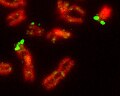 A region in the pseudoautosomal region of the short arms of the X- and Y-chromosome


