Nocardia: Difference between revisions
CSV import Tags: mobile edit mobile web edit |
CSV import Tags: mobile edit mobile web edit |
||
| Line 33: | Line 33: | ||
{{Bacteria-stub}} | {{Bacteria-stub}} | ||
{{Medicine-stub}} | {{Medicine-stub}} | ||
== Nocardia == | |||
<gallery> | |||
File:Nocardia_species_close-up_detail.jpg|Close-up detail of Nocardia species | |||
File:Nocardia_Brain_Autopsy.jpg|Nocardia infection in brain autopsy | |||
File:Four_different_Nocardia_species.jpg|Four different Nocardia species | |||
File:Nocardia_asteroides.png|Nocardia asteroides | |||
</gallery> | |||
Latest revision as of 05:06, 18 February 2025
Nocardia is a genus of bacteria that is classified as actinobacteria. It was first identified by the French veterinarian Edmond Nocard in 1888. Nocardia species are Gram-positive, aerobic, and rod-shaped, and they are found in soil and water environments around the world. Some species of Nocardia are pathogenic in humans and animals, causing Nocardiosis, a rare infectious disease.
Characteristics[edit]
Nocardia species are characterized by their branching filamentous structure, which is similar to the structure of fungi. This has led to them sometimes being mistaken for fungi in the past. They are also acid-fast, a characteristic they share with the related genus Mycobacterium.
Nocardia species are capable of degrading a wide range of organic compounds, and they play an important role in the carbon cycle. Some species are also able to degrade pollutants, and they have potential uses in bioremediation.
Pathogenicity[edit]
Several species of Nocardia are pathogenic in humans and animals. The most common disease caused by Nocardia is Nocardiosis, which can manifest as a pulmonary, cutaneous, or systemic infection. Nocardiosis is most often seen in individuals with weakened immune systems, such as those with HIV/AIDS, but it can also occur in healthy individuals.
Nocardia infections are usually acquired through inhalation of the bacteria, or through direct contact with a contaminated source. The bacteria can cause a range of symptoms, from localized skin infections to serious lung and brain infections. Treatment typically involves long-term antibiotic therapy.
Treatment and Prevention[edit]
Nocardiosis is typically treated with antibiotics, with sulfonamides being the most commonly used. However, some species of Nocardia are resistant to certain antibiotics, and susceptibility testing is often necessary to determine the most effective treatment.
Prevention of Nocardia infections primarily involves avoiding exposure to the bacteria, particularly for individuals with weakened immune systems. This can include wearing protective clothing when handling soil or compost, and using air filters in environments where dust may be contaminated with Nocardia.
See Also[edit]


Nocardia[edit]
-
 Close-up detail of Nocardia species
 -
 Nocardia infection in brain autopsy
 -
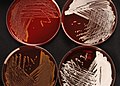 Four different Nocardia species
 -
 Nocardia asteroides


