Macroeconomics: Difference between revisions
CSV import |
CSV import |
||
| Line 41: | Line 41: | ||
[[Category:Macroeconomics]] | [[Category:Macroeconomics]] | ||
{{Economics-stub}} | {{Economics-stub}} | ||
<gallery> | |||
File:Circulation_in_macroeconomics.svg|Circulation in macroeconomics | |||
File:Okuns_law_differences_1948_to_mid_2011.png|Okun's law differences 1948 to mid 2011 | |||
File:M2_and_Inflation_USA.svg|M2 and Inflation USA | |||
File:John_Maynard_Keynes.jpg|John Maynard Keynes | |||
File:Diagram_of_natural_resource_flows-en.svg|Diagram of natural resource flows | |||
File:Islm.svg|IS-LM model | |||
File:AS_+_AD_graph.svg|Aggregate Supply and Aggregate Demand graph | |||
</gallery> | |||
Latest revision as of 11:23, 18 February 2025
Macroeconomics is a branch of economics that studies the behavior and performance of an economy as a whole. It focuses on the aggregate changes in the economy such as GDP, unemployment rates, and inflation to understand how the whole economy functions. Macroeconomists develop models that explain the relationship between such factors as national income, output, consumption, unemployment, inflation, savings, investment, international trade, and international finance.
Overview[edit]
Macroeconomics differs from microeconomics, which focuses on smaller factors that affect individual's decisions. Instead, macroeconomics analyzes the entire economy and issues affecting it, including unemployment, inflation, economic growth, and monetary and fiscal policy.
History[edit]
The term 'Macroeconomics' started to be used in the 1940s by the Norwegian economist Ragnar Anton Kittil Frisch. The field evolved out of the Great Depression, which contradicted the classical assumption that markets generally maintain an equilibrium.
Key Concepts[edit]
Gross Domestic Product[edit]
GDP is a measure of economic activity within a country. It's the market value of all goods and services produced in a year within a country's borders.
Unemployment[edit]
Unemployment refers to the number of people in an economy who are willing but unable to find work. The unemployment rate is the number of unemployed people as a percentage of the total labor force.
Inflation[edit]
Inflation is the rate at which the general level of prices for goods and services is rising, and subsequently, purchasing power is falling.
Macroeconomic Models[edit]
Macroeconomic models are simplified representations of the economy that help in understanding the relationships between different factors and how the economy functions. The most common macroeconomic models include the IS-LM model, the Mundell-Fleming model, and the AD-AS model.
Macroeconomic Policy[edit]
Macroeconomic policy is usually implemented through two sets of tools: Fiscal policy and Monetary policy. Fiscal policy relates to government spending and revenue collection, while monetary policy is the domain of the country's central bank and involves controlling the money supply and interest rates.
See Also[edit]

-
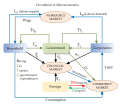 Circulation in macroeconomics
 -
Okun's law differences 1948 to mid 2011
-
M2 and Inflation USA
-
John Maynard Keynes
-
Diagram of natural resource flows
-
IS-LM model
-
Aggregate Supply and Aggregate Demand graph


