Icebox: Difference between revisions
CSV import |
CSV import |
||
| Line 29: | Line 29: | ||
[[Category:Cooling technology]] | [[Category:Cooling technology]] | ||
{{Appliance-stub}} | {{Appliance-stub}} | ||
<gallery> | |||
File:Ice_box_used_in_cafes_of_Paris_in_late_1800s.jpg|Ice box used in cafes of Paris in late 1800s | |||
File:Ice_Sheet.jpg|Ice Sheet | |||
File:Iceboxes.jpg|Iceboxes | |||
File:Girls_deliver_ice._Heavy_work_that_formerly_belonged_to_men_only_is_being_done_by_girls._The_ice_girls_are_delivering..._-_NARA_-_533758.tif|Girls deliver ice | |||
</gallery> | |||
Latest revision as of 04:34, 18 February 2025
Icebox
An Icebox is a compact, non-mechanical refrigerator that was commonly used before the invention of the electric refrigerator. Iceboxes were a common household appliance until they were gradually replaced by electric refrigerators during the 20th century.
History[edit]
The concept of the icebox dates back to the early 19th century. The first models were made of wood and insulated with cork or sawdust. They were lined with tin or zinc and a block of ice was placed inside to keep the contents cool. The ice was often delivered by an ice delivery service, which was a common profession during that time.
Design and Function[edit]
The design of the icebox is relatively simple. It consists of a box with a compartment for the ice and another compartment for the food. The ice compartment is usually located at the top of the box to allow the cold air, which is denser than warm air, to flow down and cool the food compartment. The box is insulated to slow down the melting of the ice and the heat transfer from the outside.
The icebox functions by using the principle of heat transfer. The ice absorbs the heat from the food compartment, thereby lowering the temperature and preserving the food. The melted ice, or water, is collected in a drip pan and needs to be emptied regularly.
Impact and Legacy[edit]
The icebox played a significant role in the preservation of food before the advent of electric refrigeration. It allowed for the safe storage of perishable food items and helped to improve the diet and health of people during that time.
Even though the icebox has been largely replaced by modern refrigeration, it still holds a place in history and is often seen as a symbol of a bygone era. Some people still use iceboxes today, particularly for outdoor activities such as camping or picnicking.
See Also[edit]
This appliance related article is a stub. You can help WikiMD by expanding it.
-
 Ice box used in cafes of Paris in late 1800s
 -
 Ice Sheet
 -
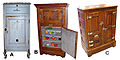 Iceboxes
 -
 Girls deliver ice


