Limerick: Difference between revisions
CSV import |
CSV import |
||
| Line 34: | Line 34: | ||
[[Category:Literature]] | [[Category:Literature]] | ||
{{poetry-stub}} | {{poetry-stub}} | ||
<gallery> | |||
File:Map_of_limerick.png|Limerick | |||
File:Limerick-King-Johns-Castle-2012.JPG|King John's Castle | |||
File:DV405_no.235_Limerick.png|Limerick | |||
File:George_Street,_Limerick_(5691906290).jpg|George Street, Limerick | |||
File:Limerick_arms.jpg|Limerick Arms | |||
File:OConnell.JPG|O'Connell | |||
File:Hunt_Museum_Limerick.jpg|Hunt Museum, Limerick | |||
File:Belltable.jpg|Belltable | |||
File:Radio_House,_Limerick_Live_95.jpg|Radio House, Limerick Live 95 | |||
File:Limerick_-_RTE_Lyric_FM_(Robert_Street)_(5771337206).jpg|RTÉ Lyric FM, Robert Street | |||
File:LimerickSunsetPotatoMarket.jpg|Limerick Sunset at Potato Market | |||
File:St_Johns_Cathedral_Limerick_Ireland.jpg|St John's Cathedral, Limerick | |||
</gallery> | |||
Revision as of 11:59, 18 February 2025
Limerick is a form of verse, often humorous and sometimes obscene, in five-line, predominantly anapestic meter with a strict rhyme scheme of AABBA, in which the first, second and fifth line rhyme, while the third and fourth lines are shorter and share a different rhyme.
History
The origin of the limerick is unknown, but it has been suggested that the form originated in the city of Limerick, Ireland and was popularized by 18th century Irish soldiers. The term was first used in English in 1898 in the New English Dictionary, although the form itself has been traced back to the 11th century.
Structure
A limerick consists of five lines. The first, second, and fifth lines must have seven to ten syllables while rhyming and having the same verbal rhythm. The third and fourth lines should only have five to seven syllables; they too must rhyme with each other and have the same rhythm.
Examples
One of the most famous limericks is attributed to Edward Lear, a 19th-century English artist and writer known for his nonsensical poetry and prose:
- There was an Old Man with a beard,
- Who said, 'It is just as I feared!
- Two Owls and a Hen,
- Four Larks and a Wren,
- Have all built their nests in my beard!'
See also
References
<references />

-
 Limerick
 -
 King John's Castle
 -
 Limerick
 -
 George Street, Limerick
 -
 Limerick Arms
 -
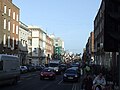 O'Connell
 -
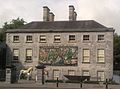 Hunt Museum, Limerick
 -
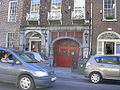 Belltable
 -
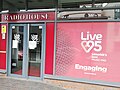 Radio House, Limerick Live 95
 -
 RTÉ Lyric FM, Robert Street
 -
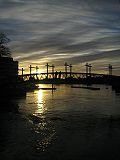 Limerick Sunset at Potato Market
 -
 St John's Cathedral, Limerick


.jpg)


_(5771337206).jpg)


