Solanine: Difference between revisions
CSV import |
CSV import |
||
| Line 27: | Line 27: | ||
{{Chemistry-stub}} | {{Chemistry-stub}} | ||
{{Medicine-stub}} | {{Medicine-stub}} | ||
<gallery> | |||
File:Solanine.svg|Chemical structure of Solanine | |||
File:CHM_275_Biosynthesis.png|Biosynthesis pathway of Solanine | |||
File:Groene_aardappels_'Doré'_(Solanum_tuberosum_'Doré').jpg|Green potatoes 'Doré' (Solanum tuberosum 'Doré') | |||
</gallery> | |||
Latest revision as of 01:36, 18 February 2025
Solanine is a glycoalkaloid poison found in species of the nightshade family within the genus Solanum, such as the potato (Solanum tuberosum), the tomato (Solanum lycopersicum), and the eggplant (Solanum melongena). It can occur naturally in any part of the plant, including the leaves, fruit, and tubers. Solanine has pesticidal properties, and it is one of the plant's natural defenses.
Chemical Structure and Properties[edit]
Solanine is a glycoside of solanidine, a steroidal alkaloid. Its structure consists of a sugar part and a non-sugar part. The sugar part is composed of a chain of three sugars (trisaccharide), and the non-sugar part (aglycone) is solanidine. Solanine is a bitter-tasting compound and is toxic to humans and animals when consumed in large quantities.
Toxicity[edit]
Solanine is toxic to humans and can lead to solanine poisoning, also known as solanine toxicity. Symptoms of solanine poisoning include nausea, diarrhea, vomiting, stomach cramps, burning of the throat, cardiac dysrhythmia, nightmares, headache, and dizziness. In severe cases, hallucinations, loss of sensation, paralysis, fever, jaundice, dilated pupils, hypothermia, and death have been reported.
Occurrence and Preparation[edit]
Solanine is not destroyed by cooking, but can be removed by peeling or dilution (as in soaking in water). It is most concentrated in the eyes, sprouts, and skin of potatoes, and in green and overripe tomatoes. It is advisable to avoid eating green potatoes or any potato with sprouts.
Uses[edit]
Despite its toxicity, solanine has been used in traditional medicine and has potential uses in modern medicine. It has been used as a sedative and an anticonvulsant, and it has been found to inhibit the growth of certain fungi and bacteria. Research is ongoing into its potential use as a treatment for certain types of cancer.
See Also[edit]


-
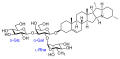 Chemical structure of Solanine
 -
 Biosynthesis pathway of Solanine
 -
 Green potatoes 'Doré' (Solanum tuberosum 'Doré')


.jpg)
