Talaromyces marneffei: Difference between revisions
CSV import Tags: mobile edit mobile web edit |
CSV import |
||
| Line 32: | Line 32: | ||
{{Fungi-stub}} | {{Fungi-stub}} | ||
{{Medicine-stub}} | {{Medicine-stub}} | ||
<gallery> | |||
File:Penicillium_marneffei_colony.jpg|Colony of Talaromyces marneffei | |||
File:James_Gathany,_CDC, CC-BY_icon.svg|Creative Commons BY icon | |||
</gallery> | |||
Revision as of 01:20, 18 February 2025
Talaromyces marneffei (formerly known as Penicillium marneffei) is a thermally dimorphic fungus that can cause systemic mycosis in humans. It is endemic in Southeast Asia and Southern China, and is particularly associated with HIV-infected individuals.
Taxonomy
The fungus was first described in 1956 by Gabriel Segretain, who isolated it from a bamboo rat in Vietnam. It was initially classified in the genus Penicillium, but was later reclassified to the genus Talaromyces based on phylogenetic analysis.
Morphology
Talaromyces marneffei is a thermally dimorphic fungus, meaning it can exist in two different forms depending on the temperature. At room temperature (25°C), it grows as a mold with septate hyphae and produces conidia. At body temperature (37°C), it transforms into a yeast form.
Pathogenesis and Clinical Manifestations
Talaromyces marneffei can cause a systemic mycosis known as talaromycosis or Penicillium marneffei infection. This disease is most commonly seen in individuals with impaired immune systems, particularly those with HIV/AIDS. The fungus is inhaled and can spread throughout the body, causing a wide range of symptoms including fever, weight loss, skin lesions, and respiratory, gastrointestinal, and systemic problems.
Diagnosis and Treatment
Diagnosis of Talaromyces marneffei infection is typically made by identifying the fungus in clinical specimens such as blood, bone marrow, or tissue biopsies. Treatment usually involves antifungal medications, with amphotericin B and itraconazole being the most commonly used.
Epidemiology
Talaromyces marneffei is endemic in Southeast Asia and Southern China, and is particularly associated with HIV-infected individuals. The fungus has been isolated from various environmental sources, including soil and bamboo rats.
See Also


-
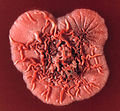 Colony of Talaromyces marneffei
 -
Creative Commons BY icon


