Finnlakeviridae: Difference between revisions
CSV import |
CSV import |
||
| Line 31: | Line 31: | ||
[[Category:Bacteriophages]] | [[Category:Bacteriophages]] | ||
{{virus-stub}} | {{virus-stub}} | ||
<gallery> | |||
File:OSD.Finnlake.Fig1.v2_WEB-Finnlakeviridae_(A).png|Finnlakeviridae | |||
File:OSD.Finnlake.Fig2.v3-FLiP-Genome.png|FLiP Genome | |||
</gallery> | |||
Latest revision as of 01:17, 18 February 2025
Finnlakeviridae is a family of viruses in the order Caudovirales, which includes viruses that infect bacteria, also known as bacteriophages. The family is named after the Finnish Lake Päijänne, where the first virus of this family was isolated.
Taxonomy[edit]
The family Finnlakeviridae is divided into two subfamilies: Alphafinnlakevirinae and Betafinnlakevirinae. Each of these subfamilies is further divided into several genera and species.
Structure[edit]
Viruses in Finnlakeviridae are non-enveloped, with icosahedral and Head-Tail geometries. The diameter is around 60-70 nm. Genomes are linear, around 40-50kb in length.
Life Cycle[edit]
Viral replication is cytoplasmic. Entry into the host cell is achieved by adsorption into the host cell. DNA-templated transcription is the method of transcription. The virus exits the host cell by lysis, and holin/endolysin/spanin proteins are involved. Bacteria serve as the natural host. Transmission routes are passive diffusion.
History[edit]
The family Finnlakeviridae was first proposed in 2019 by a group of researchers led by Elina Laanto. The proposal was based on the analysis of the genome and morphology of a new bacteriophage isolated from Lake Päijänne in Finland. The proposal was accepted by the International Committee on Taxonomy of Viruses (ICTV) in 2020.
See Also[edit]
References[edit]
<references />

-
 Finnlakeviridae
 -
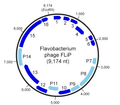 FLiP Genome
.png)

