Nuclear weapons testing: Difference between revisions
CSV import Tags: mobile edit mobile web edit |
CSV import |
||
| Line 28: | Line 28: | ||
{{military-stub}} | {{military-stub}} | ||
{{weapons-stub}} | {{weapons-stub}} | ||
<gallery> | |||
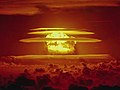
File:Castle_Bravo_nuclear_test_(cropped).jpg|Nuclear weapons testing | |||
File:Types_of_nuclear_testing.svg|Nuclear weapons testing | |||
File:NTS_-_LLNL_subcritical_experiment.jpg|Nuclear weapons testing | |||
File:Phoenix_en_route_to_North_Vietnam,_1967.jpg|Nuclear weapons testing | |||
File:Wfm_sts_overview.png|Nuclear weapons testing | |||
File:Bravo_fallout2.png|Nuclear weapons testing | |||
File:US_fallout_exposure.png|Nuclear weapons testing | |||
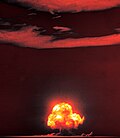
File:Trinity_shot_color.jpg|Nuclear weapons testing | |||
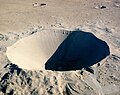
File:Sedan_Plowshare_Crater.jpg|Nuclear weapons testing | |||
File:330-PS-3256_(45898_AC)_(17204655228).jpg|Nuclear weapons testing | |||
File:Rael_Nuclear_use_locations_world_map.png|Nuclear weapons testing | |||
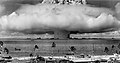
File:Operation_Crossroads_Baker_Edit.jpg|Nuclear weapons testing | |||
</gallery> | |||
Latest revision as of 11:52, 18 February 2025
Nuclear weapons testing refers to the practice of testing nuclear weapons, and is a critical part of the nuclear weapons development process. The tests are conducted to verify the effectiveness and destructive power of nuclear weapons, and to ensure their reliability and safety.
History[edit]
The history of nuclear weapons testing dates back to the mid-20th century, when the United States conducted the first nuclear test, codenamed Trinity, on July 16, 1945. This was followed by the Soviet Union's first nuclear test, codenamed First Lightning, in 1949. Since then, several other countries, including UK, France, China, and India, have conducted their own nuclear tests.
Types of Nuclear Tests[edit]
Nuclear weapons tests can be classified into two main types: atmospheric and underground tests. Atmospheric tests are conducted in the atmosphere and are generally more destructive and harmful due to the release of radioactive fallout. Underground tests, on the other hand, are conducted below the surface of the earth and are less harmful as they contain the radioactive fallout.
Effects of Nuclear Testing[edit]
The effects of nuclear weapons testing are far-reaching and devastating. They include immediate destruction caused by the blast, long-term environmental damage, and health effects due to exposure to radiation. The Partial Test Ban Treaty of 1963, which prohibits all test detonations of nuclear weapons except for those conducted underground, was a significant step towards limiting the harmful effects of nuclear testing.
Nuclear Testing and International Law[edit]
Nuclear weapons testing has been a contentious issue in international law. The Comprehensive Nuclear-Test-Ban Treaty (CTBT), which is yet to enter into force, aims to ban all nuclear explosions in all environments, for military or civilian purposes. However, not all nuclear-armed states have signed or ratified the treaty.
See Also[edit]


-
 Nuclear weapons testing
 -
 Nuclear weapons testing
 -
 Nuclear weapons testing
 -
Nuclear weapons testing
-
 Nuclear weapons testing
 -
 Nuclear weapons testing
 -
 Nuclear weapons testing
 -
 Nuclear weapons testing
 -
 Nuclear weapons testing
 -
 Nuclear weapons testing
 -
 Nuclear weapons testing
 -
 Nuclear weapons testing
.jpg)


_(17204655228).jpg)


