Australian Road Rules: Difference between revisions
CSV import |
CSV import |
||
| Line 40: | Line 40: | ||
{{Australia-stub}} | {{Australia-stub}} | ||
{{Law-stub}} | {{Law-stub}} | ||
<gallery> | |||
File:Hume Freeway Craigieburn Bypass.jpg|Hume Freeway Craigieburn Bypass | |||
File:Darwin 2173.jpg|Darwin | |||
File:Hook Turn Sign Melbourne.jpg|Hook Turn Sign Melbourne | |||
File:LaneClosureTaper.jpg|Lane Closure Taper | |||
File:Southern expressway entrance, bedford pk.jpg|Southern Expressway Entrance, Bedford Park | |||
File:Australian road train headed by Volvo NH15.jpg|Australian Road Train Headed by Volvo NH15 | |||
File:Bridge into Hobart.jpg|Bridge into Hobart | |||
</gallery> | |||
Latest revision as of 06:18, 3 March 2025
Australian Road Rules are a set of uniform laws that regulate vehicle road traffic in Australia. These rules were first introduced in 1999 by the National Road Transport Commission (NRTC) and have since been adopted by each state and territory.
History[edit]
The Australian Road Rules were developed in response to the need for uniformity among the different jurisdictions in Australia. Prior to their introduction, each state and territory had its own set of road rules, which often led to confusion for drivers travelling between jurisdictions. The NRTC, now known as the National Transport Commission (NTC), was tasked with developing a set of uniform rules that could be adopted nationwide.
Content[edit]
The Australian Road Rules cover a wide range of areas related to road use, including speed limits, vehicle standards, driver licensing, and rules for pedestrians and cyclists. They also include rules for specific situations, such as school zones, road works, and emergency situations.
Speed Limits[edit]
Under the Australian Road Rules, the default speed limit in built-up areas is 50 km/h, unless otherwise signposted. On roads outside built-up areas, the default speed limit is 100 km/h. However, these limits can be varied by road signs or by specific rules in each state or territory.
Vehicle Standards[edit]
The Australian Road Rules also set out standards for vehicles, including requirements for lights, brakes, tyres, and other equipment. These standards are designed to ensure that vehicles are safe to use on the road.
Driver Licensing[edit]
The rules also cover driver licensing, including the requirements for obtaining a driver's licence, the different types of licences, and the rules for learner and provisional drivers.
Pedestrians and Cyclists[edit]
The Australian Road Rules include specific rules for pedestrians and cyclists. These rules cover areas such as crossing the road, riding on footpaths, and using cycle lanes.
Implementation[edit]
While the Australian Road Rules are a national set of rules, they are implemented and enforced by each state and territory. This means that there can be some variations in the rules between different jurisdictions.
See Also[edit]


-
 Hume Freeway Craigieburn Bypass
 -
 Darwin
 -
 Hook Turn Sign Melbourne
 -
 Lane Closure Taper
 -
 Southern Expressway Entrance, Bedford Park
 -
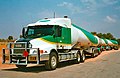 Australian Road Train Headed by Volvo NH15
 -
 Bridge into Hobart


