Deepsea Challenger: Difference between revisions
CSV import Tags: mobile edit mobile web edit |
CSV import |
||
| Line 24: | Line 24: | ||
[[Category:James Cameron]] | [[Category:James Cameron]] | ||
{{Submarine-stub}} | {{Submarine-stub}} | ||
<gallery> | |||
File:Deepsea_challenger_deep-diving_submersible_DVC1.svg|Deepsea Challenger | |||
File:Deepsea_Challenger_Top.jpg|Deepsea Challenger | |||
File:Deepsea_Challenger_Batteries.jpg|Deepsea Challenger | |||
File:Deepsea_Challenger_Thruster.jpg|Deepsea Challenger | |||
File:Deepsea_Challenger_Bottom.jpg|Deepsea Challenger | |||
File:Deepsea_Challenger_Pilot_Sphere.jpg|Deepsea Challenger | |||
File:Deepsea_Challenger_Pilot_Sphere_Hatch.JPG|Deepsea Challenger | |||
File:Deepsea_Challenger_Pilot_Sphere_Interior.jpg|Deepsea Challenger | |||
File:DeepSea_Challenger_descent_graph-2.svg|Deepsea Challenger | |||
File:DeepSea_Challenger_ascent_graph-2.svg|Deepsea Challenger | |||
</gallery> | |||
Latest revision as of 11:45, 18 February 2025
Deepsea Challenger (also known as the Deepsea Challenger submersible) is a 7.3m (24ft) deep-diving submersible designed to reach the bottom of Challenger Deep, the deepest-known point on Earth. On March 26, 2012, Canadian film director James Cameron piloted the craft to accomplish this goal in the second manned dive reaching the Challenger Deep.
Design and Development[edit]
The Deepsea Challenger was designed by Ron Allum, a specialist in high-pressure technology, and built in Sydney, Australia by the research and design company Acheron Project Pty Ltd. The submersible was developed in collaboration with the National Geographic Society and Rolex for the Deepsea Challenge expedition.
The submersible is equipped with a custom-designed syntactic foam, a composite material, to withstand the extreme pressure at the ocean's deepest point. The foam, known as ISOFLOAT, not only provides buoyancy but also protects the pilot and the sub's systems.
Expedition[edit]
On March 26, 2012, James Cameron piloted the Deepsea Challenger to the bottom of the Challenger Deep, reaching a depth of 10,908 meters (35,787 feet). The descent took approximately 2 hours and 36 minutes. During the dive, Cameron collected samples for scientific research and captured high-resolution 3D images.
Legacy[edit]
The Deepsea Challenger's successful dive has contributed significantly to our understanding of the deep ocean. The submersible's design and technology have set a new standard for deep-sea exploration. The data collected during the expedition has provided valuable insights into the biology, geology, and chemistry of the deep sea.
See also[edit]
References[edit]
<references />

-
 Deepsea Challenger
 -
 Deepsea Challenger
 -
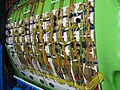 Deepsea Challenger
 -
 Deepsea Challenger
 -
 Deepsea Challenger
 -
 Deepsea Challenger
 -
 Deepsea Challenger
 -
 Deepsea Challenger
 -
 Deepsea Challenger
 -
 Deepsea Challenger


