Jajangmyeon: Difference between revisions
CSV import |
CSV import |
||
| Line 23: | Line 23: | ||
[[Category:Chinese cuisine in Korea]] | [[Category:Chinese cuisine in Korea]] | ||
{{Korea-food-stub}} | {{Korea-food-stub}} | ||
<gallery> | |||
File:Jajangmyeon.jpg|Jajangmyeon | |||
File:Jajangmyeon_by_KFoodaddict.jpg|Jajangmyeon by KFoodaddict | |||
File:Korean.cuisine-Jajangmyeon-01.jpg|Korean cuisine Jajangmyeon | |||
File:Jaengbanjajang.jpg|Jaengbanjajang | |||
File:Jajang.jpg|Jajang | |||
File:Haemul-jajangmyeon.jpg|Haemul Jajangmyeon | |||
File:농심_짜파게티_매콤한_사천_6.jpg|Nongshim Jjapagetti Spicy Sichuan | |||
</gallery> | |||
Latest revision as of 11:16, 18 February 2025
Jajangmyeon (also spelled jjajangmyeon) is a popular Korean dish, which was originally developed by Chinese immigrants in the port city of Incheon, South Korea. It is a noodle dish topped with a thick sauce made of chunjang (a salty black soybean paste), diced pork, and vegetables. Variations of the dish can include seafood or other types of meat.
History[edit]
The dish originated from the Chinese dish, Zha jiang mian, but has been adapted to Korean tastes. The first mention of jajangmyeon in Korean literature dates back to the early 20th century, during the period of Japanese rule. The dish was initially served in restaurants catering to Chinese immigrants, but quickly spread to become a popular dish among Koreans.
Preparation[edit]
Jajangmyeon is typically prepared by stir frying a mixture of chunjang, diced pork, and vegetables such as onions, zucchini, and potatoes. This mixture is then combined with water and wheat flour to create a thick, dark sauce. The sauce is served over thick, chewy noodles, typically made from wheat flour and eggs. The dish is often garnished with cucumber slices and sometimes served with a side of danmuji (yellow pickled radish).
Variations[edit]
There are several variations of jajangmyeon, including seafood jajangmyeon and gan jajang. Seafood jajangmyeon includes various types of seafood, such as shrimp and squid, in addition to the standard ingredients. Gan jajang is a version where the sauce is served separately from the noodles, allowing the diner to mix them to their preference.
Cultural significance[edit]
Jajangmyeon has a significant place in Korean culture. It is commonly eaten on Black Day, a day for single people in South Korea to mourn their single status by eating jajangmyeon, which is black in color. The dish is also a popular choice for home delivery, and is often featured in Korean television dramas and films.
See also[edit]

-
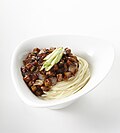 Jajangmyeon
 -
 Jajangmyeon by KFoodaddict
 -
 Korean cuisine Jajangmyeon
 -
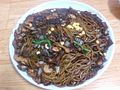 Jaengbanjajang
 -
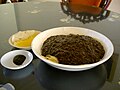 Jajang
 -
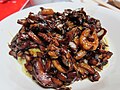 Haemul Jajangmyeon
 -
 Nongshim Jjapagetti Spicy Sichuan


