Shikoku: Difference between revisions
CSV import |
CSV import |
||
| Line 24: | Line 24: | ||
[[Category:Islands of Japan]] | [[Category:Islands of Japan]] | ||
[[Category:Shikoku]] | [[Category:Shikoku]] | ||
<gallery> | |||
File:Satellite image of Shikoku in April 2018.png|Satellite image of Shikoku in April 2018 | |||
File:Flag of Matsuyama, Ehime.svg|Flag of Matsuyama, Ehime | |||
File:Chugoku-Region-Shikoku-Japan-ISS-Space.png|Chugoku Region and Shikoku from ISS | |||
File:Geofeatures map of Shikoku Japan ja.svg|Geofeatures map of Shikoku Japan | |||
File:Mount Ishizuchi.jpg|Mount Ishizuchi | |||
File:Ashizurimisaki Cape.JPG|Ashizurimisaki Cape | |||
File:Shimanto sada chinkabashi fukin.jpg|Shimanto sada chinkabashi fukin | |||
File:Seto-Inland-Sea-Photo.jpg|Seto Inland Sea Photo | |||
File:Views from Matsuyama Castle (Iyo) 20170123-5.jpg|Views from Matsuyama Castle (Iyo) | |||
File:Flag of Matsuyama, Ehime.svg|Flag of Matsuyama, Ehime | |||
</gallery> | |||
Latest revision as of 05:41, 3 March 2025
Shikoku is the smallest and least populous of the four main islands of Japan. It is located south of Honshu and is separated from it by the Seto Inland Sea. The island is divided into four prefectures: Ehime, Kagawa, Kochi, and Tokushima.
Geography[edit]
Shikoku's geography is characterized by its mountainous terrain, with the Shikoku Mountain Range running east to west across the island. The highest peak is Mount Ishizuchi, which is also the highest mountain in western Japan. The island is also known for its rivers, including the Shimanto River, often referred to as "Japan's last clear stream" due to its pristine waters.
Economy[edit]
The economy of Shikoku is largely based on agriculture, fishing, and small-scale industry. The island is known for its production of citrus fruits, such as yuzu, sudachi, and mikan. It is also a major producer of sake and paper.
Culture[edit]
Shikoku is famous for the Shikoku Pilgrimage, a 1,200-kilometer route that circles the island and covers 88 Buddhist temples. The pilgrimage is associated with Kobo Daishi, the founder of Shingon Buddhism in Japan. Shikoku is also known for its traditional Awa Odori dance festival, which takes place in Tokushima every August.
Cuisine[edit]
Shikoku's cuisine is diverse and heavily influenced by its agricultural and marine resources. Notable dishes include Sanuki udon, a type of noodle dish from Kagawa, and Katsuo no tataki, a lightly seared and sliced bonito dish from Kochi.
Transportation[edit]
Shikoku is connected to Honshu by three expressways, which are part of the Honshu-Shikoku Bridge Project. The island's internal transportation is serviced by the Shikoku Railway Company, and there are also numerous ferry routes connecting Shikoku with the other islands of Japan.
See also[edit]

-
 Satellite image of Shikoku in April 2018
 -
 Flag of Matsuyama, Ehime
 -
 Chugoku Region and Shikoku from ISS
 -
 Geofeatures map of Shikoku Japan
 -
 Mount Ishizuchi
 -
 Ashizurimisaki Cape
 -
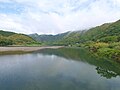 Shimanto sada chinkabashi fukin
 -
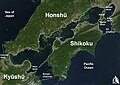 Seto Inland Sea Photo
 -
 Views from Matsuyama Castle (Iyo)
 -
Flag of Matsuyama, Ehime


_20170123-5.jpg)
