Gymnosporangium globosum: Difference between revisions
CSV import Tags: mobile edit mobile web edit |
CSV import Tags: mobile edit mobile web edit |
||
| Line 25: | Line 25: | ||
{{Plant-disease-stub}} | {{Plant-disease-stub}} | ||
{{food-stub}} | {{food-stub}} | ||
== Gymnosporangium globosum gallery == | |||
<gallery> | |||
File:Gymnosporangium globosum.jpg|Gymnosporangium globosum | |||
File:Gymnosporangium globosum 1.jpg|Gymnosporangium globosum 1 | |||
File:Gymnosporangium globosum 2.jpg|Gymnosporangium globosum 2 | |||
File:Two-celled teliospore of Gymnosporangium globosum.jpg|Two-celled teliospore of Gymnosporangium globosum | |||
</gallery> | |||
Latest revision as of 06:00, 3 March 2025
Gymnosporangium globosum is a species of fungus in the family Pucciniaceae. It is a plant pathogen that primarily affects members of the juniper family.
Description[edit]
The Gymnosporangium globosum fungus is characterized by its unique life cycle, which involves two different host plants. The fungus spends part of its life cycle on junipers, where it produces orange, gelatinous teliospores during wet weather. These spores are then carried by the wind to the secondary host, typically an apple or pear tree, where they germinate and infect the tree, causing a disease known as cedar-apple rust.
Life Cycle[edit]
The life cycle of Gymnosporangium globosum is complex and involves two different host plants. The fungus overwinters on junipers as a hard, brownish gall. In the spring, during wet weather, these galls swell and produce orange, gelatinous teliospores. These spores are then carried by the wind to the secondary host, typically an apple or pear tree. Once on the secondary host, the spores germinate and infect the tree, causing a disease known as cedar-apple rust. The fungus then produces aeciospores, which are carried by the wind back to a juniper, completing the life cycle.
Impact[edit]
Gymnosporangium globosum is a significant pathogen of both junipers and apple or pear trees. The disease it causes, cedar-apple rust, can result in significant yield losses for apple and pear growers. In addition, the disease can weaken and eventually kill junipers.
Control[edit]
Control of Gymnosporangium globosum involves a combination of cultural practices and chemical treatments. Cultural practices include planting resistant varieties of apples and pears, and removing and destroying infected junipers. Chemical treatments include the application of fungicides to both the junipers and the apple or pear trees.
See Also[edit]


This article is a plant disease stub. You can help WikiMD by expanding it!

Gymnosporangium globosum gallery[edit]
-
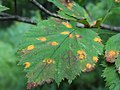 Gymnosporangium globosum
 -
 Gymnosporangium globosum 1
 -
 Gymnosporangium globosum 2
 -
 Two-celled teliospore of Gymnosporangium globosum


