Schizophyllum commune: Difference between revisions
CSV import Tags: mobile edit mobile web edit |
CSV import |
||
| Line 30: | Line 30: | ||
[[Category:Schizophyllaceae]] | [[Category:Schizophyllaceae]] | ||
{{Fungus-stub}} | {{Fungus-stub}} | ||
<gallery> | |||
File:Schizophyllum_commune_(Split_gill)_(33389628036).jpg|Schizophyllum commune (Split gill) | |||
File:Schizophyllum_commune_SMCA_02.jpg|Schizophyllum commune SMCA 02 | |||
File:Schizophyllum_commune,_Fuzzy_Fungi.jpg|Schizophyllum commune, Fuzzy Fungi | |||
File:Schizophyllum_commune_-_Nature_does_pleats.jpg|Schizophyllum commune - Nature does pleats | |||
File:Split-gill_bottom_shot.jpg|Split-gill bottom shot | |||
</gallery> | |||
Latest revision as of 20:51, 25 February 2025
Schizophyllum commune is a species of fungus in the family Schizophyllaceae. It is a common all over the world and has the ability to colonize a wide range of substrates, both natural and synthetic.
Taxonomy[edit]
The species was first described scientifically by Carl Linnaeus in 1753. The generic name Schizophyllum means "split gill", and commune is Latin for "common".
Description[edit]
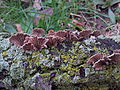
The fruit body of Schizophyllum commune is a small, fan or oyster-shaped bracket, typically 1–4 cm across. The upper surface is covered in dense, short, greyish-white hairs. The fertile, spore-bearing surface is composed of gills that are split lengthwise, hence the common name "split gill".
Distribution and habitat[edit]
Schizophyllum commune is a saprophytic fungus, meaning it obtains its nutrients from dead or decaying organic matter. It is commonly found on decaying hardwoods, although it can also colonize the wounds of living trees.
Uses[edit]
Schizophyllum commune has been used in traditional medicine in various cultures around the world. It has also been studied for its potential in bioremediation, due to its ability to colonize and break down a wide range of substrates.
See also[edit]
References[edit]
<references />

-
 Schizophyllum commune (Split gill)
 -
 Schizophyllum commune SMCA 02
 -
 Schizophyllum commune, Fuzzy Fungi
 -
 Schizophyllum commune - Nature does pleats
 -
 Split-gill bottom shot
_(33389628036).jpg)


