Luffa aegyptiaca: Difference between revisions
CSV import |
CSV import |
||
| Line 24: | Line 24: | ||
{{Cucurbitaceae-stub}} | {{Cucurbitaceae-stub}} | ||
{{food-stub}} | {{food-stub}} | ||
<gallery> | |||
File:Luffa_aegyptiaca_compose.jpg|Luffa aegyptiaca | |||
File:Luffa_aegyptiaca_Blanco2.334-cropped.jpg|Luffa aegyptiaca | |||
File:Luffa_sponge.png|Luffa sponge | |||
File:2008.09-331-196ap_Sponge_gourd,pd_Spice_Bazaar@Istanbul,TR_mon29sep2008-1315h.jpg|Sponge gourd at Spice Bazaar, Istanbul | |||
File:Sponge_gourd_of_Bangladesh.jpg|Sponge gourd of Bangladesh | |||
File:Kursi,_Golan_Heights_12.JPG|Luffa aegyptiaca | |||
File:Beth_Alfa_Synagogue_Mosaic_08.JPG|Luffa aegyptiaca | |||
</gallery> | |||
Revision as of 12:22, 18 February 2025
Luffa aegyptiaca is a species of Luffa, a genus in the Cucurbitaceae family. It is commonly known as the sponge gourd, Egyptian cucumber, or Vietnamese luffa. It is a tropical and subtropical vine, native to South Asia and Southeast Asia, but now grown extensively in other regions as well.
Description
Luffa aegyptiaca is an annual climbing vine with tendrils, and large, yellow flowers. The plant is monoecious, with separate male and female flowers on the same plant. The fruit of the plant, the sponge gourd, is a cylindrical vegetable, with a smooth green skin and a white interior.
Cultivation
Luffa aegyptiaca is grown for its fruit, which is harvested and consumed as a vegetable when immature. The plant requires a long, warm growing season, and is typically grown from seed. It is a popular vegetable in many Asian cuisines, and is also used in traditional medicine.
Uses
When the fruit of the Luffa aegyptiaca is allowed to mature, it becomes fibrous and can be processed into a sponge-like texture. These natural sponges are used for bathing and cleaning. The plant is also used in traditional medicine, particularly in Asia, for a variety of ailments.
Nutrition
The immature fruit of the Luffa aegyptiaca is a good source of dietary fiber, vitamin C, and potassium. It is low in calories and fat.
See also
| 🌱 | This Cucurbitaceae related article is a stub. |

-
 Luffa aegyptiaca
 -
 Luffa aegyptiaca
 -
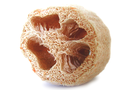 Luffa sponge
 -
 Sponge gourd at Spice Bazaar, Istanbul
 -
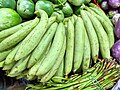 Sponge gourd of Bangladesh
 -
 Luffa aegyptiaca
 -
 Luffa aegyptiaca


