Zamboanga City: Difference between revisions
No edit summary |
CSV import |
||
| Line 29: | Line 29: | ||
[[Category:Zamboanga Peninsula]] | [[Category:Zamboanga Peninsula]] | ||
{{Philippines-geo-stub}} | {{Philippines-geo-stub}} | ||
<gallery> | |||
File:Zamboanga Cathedral (La Purisima, Zamboanga City; 10-06-2023).jpg|Zamboanga Cathedral (La Purisima, Zamboanga City; 10-06-2023) | |||
File:Isla Great Santa Cruz53.JPG|Isla Great Santa Cruz | |||
File:Pasonanca Natural Park.jpg|Pasonanca Natural Park | |||
File:Flag of Zamboanga.jpg|Flag of Zamboanga | |||
File:Samboangan 1734.jpg|Samboangan 1734 | |||
File:Inaugurateprvincialgovzamboanga.jpg|Inauguration of Provincial Government of Zamboanga | |||
File:President Quezon signing the Zamboanga City Charter at the Malacañang Palace on October 12, 1936.jpg|President Quezon signing the Zamboanga City Charter at the Malacañang Palace on October 12, 1936 | |||
File:Sadik Grand Mosque project (MLCC Highway, Pasobolong, Zamboanga City; 10-12-2023).jpg|Sadik Grand Mosque project (MLCC Highway, Pasobolong, Zamboanga City; 10-12-2023) | |||
File:La Purisima Street at Night (May 2023).jpg|La Purisima Street at Night (May 2023) | |||
</gallery> | |||
Latest revision as of 06:01, 3 March 2025
Zamboanga City is a highly urbanized city located in the island of Mindanao, Philippines. It is the sixth most populous city in the country and the third largest by land area. Known as the "City of Flowers" (Ciudad de Flores), it is now one of the most important and busiest port cities in the Philippines.
History[edit]
Zamboanga City was formerly a part of the Sultanate of Sulu, an Islamic state that ruled over much of the southern Philippines. In the late 19th century, it was ceded to the Spanish Empire, which established a military fort in the city. The city was incorporated into the Philippines after the country gained independence from the United States in 1946.
Geography[edit]
Zamboanga City is located on the southwestern tip of the Zamboanga Peninsula. It is surrounded by the Sulu Sea to the west, the Moro Gulf to the east, and the Celebes Sea to the south. The city's topography is characterized by coastal plains, valleys, and hills.
Economy[edit]
The economy of Zamboanga City is largely based on fishing, agriculture, and trade. It is a major hub for sardine production and exports, earning it the nickname "Sardines Capital of the Philippines". The city is also known for its rubber plantations and the production of seaweed, which is exported to countries like China and Japan.
Culture[edit]
Zamboanga City is known for its unique blend of cultures, with influences from the indigenous Subanon people, Spanish colonizers, and Muslim communities. The city is famous for its annual Hermosa Festival, which celebrates the city's cultural heritage and the feast of Our Lady of the Pillar.
Education[edit]
Zamboanga City is home to several universities and colleges, including the Western Mindanao State University, Ateneo de Zamboanga University, and Zamboanga State College of Marine Sciences and Technology.
Transportation[edit]
Zamboanga City is served by the Zamboanga International Airport, the third busiest airport in Mindanao. The city also has a major seaport, which serves as a gateway to other parts of the Philippines and neighboring countries.

-
Zamboanga Cathedral (La Purisima, Zamboanga City; 10-06-2023)
-
 Isla Great Santa Cruz
 -
 Pasonanca Natural Park
 -
 Flag of Zamboanga
 -
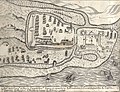 Samboangan 1734
 -
 Inauguration of Provincial Government of Zamboanga
 -
 President Quezon signing the Zamboanga City Charter at the Malacañang Palace on October 12, 1936
 -
Sadik Grand Mosque project (MLCC Highway, Pasobolong, Zamboanga City; 10-12-2023)
-
 La Purisima Street at Night (May 2023)


.jpg)

.jpg)
.jpg)