Tapioca pearl: Difference between revisions
CSV import |
CSV import |
||
| Line 34: | Line 34: | ||
[[Category:Starch]] | [[Category:Starch]] | ||
{{food-stub}} | {{food-stub}} | ||
<gallery> | |||
File:Tapioca_balls_(4507369304).jpg|Tapioca pearls | |||
File:Sabudana_in_bowl.jpg|Sabudana in bowl | |||
File:Ginataang_Bilu-Bilo_001.jpg|Ginataang Bilu-Bilo | |||
File:Es_Campur.jpg|Es Campur | |||
File:Sagu-restaurante-sobremesa.jpg|Sagu dessert | |||
File:Bubble_Tea.png|Bubble Tea | |||
File:A_giant_brick_of_boba_bubbles.jpg|A giant brick of boba bubbles | |||
</gallery> | |||
Latest revision as of 11:09, 18 February 2025
Tapioca Pearl
Tapioca pearls, also known as boba in some cultures, are small, round balls made from tapioca, a starch extracted from the cassava root. They are a common ingredient in various foods and beverages, most notably in bubble tea, a popular Asian drink.
History[edit]
Tapioca pearls originated from Southeast Asia and have been used in traditional dishes for centuries. The pearls are made by rolling the tapioca starch into balls, which are then boiled until they become soft and gelatinous. The popularity of tapioca pearls has spread globally, largely due to the rise of bubble tea shops.
Production[edit]
The production of tapioca pearls involves a process of extracting starch from the cassava root, which is then formed into a dough. The dough is rolled into small balls, which are then boiled to create the soft, chewy texture that tapioca pearls are known for. The pearls are often colored with food coloring or caramel to give them a distinct appearance.
Uses[edit]
Tapioca pearls are used in a variety of dishes and beverages. They are a key ingredient in bubble tea, a drink that combines tea, milk, sugar, and tapioca pearls. The pearls are also used in desserts, such as puddings and sweet soups, and can be used as a thickening agent in certain recipes.
Nutritional Value[edit]
Tapioca pearls are primarily carbohydrates, with little protein or fiber. They are also low in vitamins and minerals. However, they are gluten-free and can be a good option for those with celiac disease or a sensitivity to gluten.
Cultural Significance[edit]
In many cultures, tapioca pearls have a significant cultural role. In Taiwan, for example, they are a key component of bubble tea, a drink that has become a symbol of Taiwanese culture. In other parts of Asia, tapioca pearls are used in traditional desserts and are a staple in many households.
See Also[edit]

-
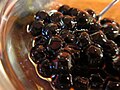 Tapioca pearls
 -
 Sabudana in bowl
 -
 Ginataang Bilu-Bilo
 -
 Es Campur
 -
 Sagu dessert
 -
 Bubble Tea
 -
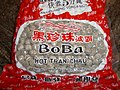 A giant brick of boba bubbles
.jpg)


