Bambara people: Difference between revisions
CSV import Tags: mobile edit mobile web edit |
CSV import |
||
| Line 24: | Line 24: | ||
{{African ethnic group-stub}} | {{African ethnic group-stub}} | ||
{{food-stub}} | {{food-stub}} | ||
== Bambara people gallery == | |||
<gallery> | |||
File:BambaraSenegal.jpg|Bambara Senegal | |||
File:Bambara girls work.jpg|Bambara girls work | |||
File:Bambarra interior, from 1892 book The Story of Africa and its Explorers.png|Bambarra interior, from 1892 book The Story of Africa and its Explorers | |||
File:Bambara archer.jpg|Bambara archer | |||
File:Pg031 Types de cases bambara.jpg|Types de cases bambara | |||
File:Bambara Smithsonian 6-10-07 026.jpg|Bambara Smithsonian 6-10-07 026 | |||
</gallery> | |||
Latest revision as of 06:08, 3 March 2025
Bambara people are an ethnic group native to much of West Africa, primarily in Mali, but also in Guinea, Burkina Faso, and Senegal. They are considered the largest ethnic group in Mali, comprising about 36% of the country's population. The Bambara people are part of the larger Mande ethnic group.
History[edit]
The Bambara people trace their origins back to the Mande Empire, a powerful West African state that existed from the 13th to the 17th centuries. The empire was known for its cultural, economic, and political influence across West Africa. The Bambara people are believed to have migrated to their current locations in Mali and surrounding countries following the fall of the Mande Empire.
Language[edit]
The Bambara people speak Bambara, a Mande language that is one of the national languages of Mali. It is spoken by millions of people in the country, not just the Bambara people, and is used as a lingua franca in many areas.
Culture[edit]
Bambara culture is rich and diverse, with a strong emphasis on oral tradition. Storytelling, music, and dance are all important aspects of Bambara culture. The Bambara people are also known for their craftsmanship, particularly in the areas of wood carving, textile weaving, and blacksmithing.
Religion[edit]
The majority of Bambara people practice Islam, which was introduced to the region by Arab traders in the 11th century. However, traditional African religions and beliefs continue to play a significant role in Bambara religious practices.
Society[edit]
Bambara society is traditionally organized into castes, with each caste having a specific role or occupation. These include farmers, blacksmiths, warriors, and griots (storytellers and musicians). This caste system, while less rigid today, continues to influence Bambara social structure.
Economy[edit]
The Bambara people are primarily farmers, growing crops such as millet, rice, and peanuts. They also raise livestock, including cattle, sheep, and goats. In addition to farming, many Bambara people are involved in trade and craftsmanship.
This African ethnic group related article is a stub. You can help WikiMD by expanding it.

Bambara people gallery[edit]
-
 Bambara Senegal
 -
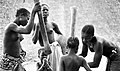 Bambara girls work
 -
 Bambarra interior, from 1892 book The Story of Africa and its Explorers
 -
 Bambara archer
 -
 Types de cases bambara
 -
 Bambara Smithsonian 6-10-07 026


