Blue agave: Difference between revisions
CSV import Tags: mobile edit mobile web edit |
CSV import |
||
| Line 28: | Line 28: | ||
[[Category:Plants used in traditional Mexican medicine]] | [[Category:Plants used in traditional Mexican medicine]] | ||
{{food-stub}} | {{food-stub}} | ||
<gallery> | |||
File:Agave tequilana 1.jpg|Agave tequilana 1 | |||
File:Agave tequilana0.jpg|Agave tequilana 0 | |||
</gallery> | |||
Latest revision as of 05:30, 3 March 2025
Blue Agave (Agave tequilana) is a species of agave native to Mexico. It is well known for its use in the production of tequila, a popular distilled beverage.
Description[edit]
Blue agave plants are large, succulent plants with spiky, bluish-green leaves. They can grow up to 2 meters in height and spread out up to 2 meters wide. The leaves are thick and fleshy, with sharp spines along the edges and a particularly sharp spine at the tip.
Cultivation[edit]
Blue agave is primarily cultivated in the Mexican states of Jalisco, Nayarit, Guanajuato, Michoacán, and Tamaulipas. The soil in these regions is rich in volcanic minerals, which contributes to the unique flavor of tequila. Blue agave plants take between 8 and 10 years to mature and can only be harvested once.
Uses[edit]
The primary use of blue agave is in the production of tequila. The heart of the plant, known as the piña, is harvested and cooked to convert the plant's natural sugars into fermentable sugars. The cooked piñas are then crushed to extract the juice, which is fermented and distilled to produce tequila.
Blue agave is also used to produce agave syrup, a sweetener that is often used as a vegan alternative to honey. The syrup is made by heating and filtering the sap of the blue agave plant.
Health Benefits[edit]
Blue agave is rich in fructans, a type of prebiotic fiber that can promote digestive health. Some studies also suggest that blue agave may have anti-inflammatory and antioxidant properties.
See Also[edit]
References[edit]
<references />

-
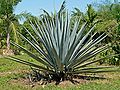 Agave tequilana 1
 -
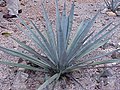 Agave tequilana 0


