Testaroli: Difference between revisions
CSV import Tags: mobile edit mobile web edit |
CSV import |
||
| Line 28: | Line 28: | ||
{{Italian-food-stub}} | {{Italian-food-stub}} | ||
{{food-stub}} | {{food-stub}} | ||
<gallery> | |||
File:Testaroli-Pesto-Pontremoli-2800.jpg|Testaroli with pesto in Pontremoli | |||
File:Testaroli,_taglio.jpg|Cutting Testaroli | |||
File:Boba_bar_process.jpg|Boba bar process | |||
</gallery> | |||
Latest revision as of 00:52, 18 February 2025
Testaroli is a type of pasta originating from the regions of Liguria and Tuscany in Italy. It is considered one of the oldest forms of pasta and is traditionally made from a batter of wheat flour, water, and salt.
History[edit]
Testaroli has a rich history dating back to the Etruscan civilization, making it one of the oldest known types of pasta. The name "Testaroli" is derived from "testo", a type of terracotta cooking utensil used by the Etruscans.
Preparation[edit]
The batter for Testaroli is made by mixing wheat flour, water, and salt. This mixture is then poured into a hot, flat pan known as a "testo" and cooked until it forms a thin pancake. The pancake is then cut into squares or diamonds and briefly boiled before serving.
Traditionally, Testaroli is served with pesto, a sauce originating from Liguria, or with a simple sauce of olive oil, garlic, and Parmesan cheese. However, it can also be served with a variety of other sauces according to personal preference.
Cultural Significance[edit]
Testaroli is a significant part of the culinary heritage of Liguria and Tuscany. It is often prepared for special occasions and is a staple in many traditional Italian dishes. The unique preparation method and long history of Testaroli make it a distinctive part of Italian cuisine.
See Also[edit]

-
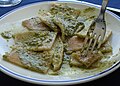 Testaroli with pesto in Pontremoli
 -
 Cutting Testaroli
 -
 Boba bar process


