Yeast extract: Difference between revisions
CSV import Tags: mobile edit mobile web edit |
CSV import Tags: mobile edit mobile web edit |
||
| Line 31: | Line 31: | ||
[[Category:Yeast]] | [[Category:Yeast]] | ||
{{food-stub}} | {{food-stub}} | ||
<gallery> | |||
File:Soup_au_Pistou.jpg|Soup au Pistou | |||
File:Marmite.jpg|Marmite | |||
File:Vegemite_(15908411205).jpg|Vegemite | |||
File:Marmite_Returns_to_New_Zealand.jpg|Marmite Returns to New Zealand | |||
File:A_jar_of_Vitam-R_yeast_paste.jpg|A jar of Vitam-R yeast paste | |||
File:Cenovis.jpg|Cenovis | |||
</gallery> | |||
Latest revision as of 05:04, 18 February 2025
Yeast extract is a food flavoring made from the same yeast used to make bread and beer. It is a byproduct of yeast fermentation and is rich in several nutrients.
History[edit]
Yeast extract has been used as a food additive for many years. It was first developed in the 19th century by German scientist Justus von Liebig. Liebig discovered that yeast could be concentrated and used as a flavor enhancer, leading to the creation of the first commercial yeast extract product, Marmite, in the United Kingdom in 1902.
Production[edit]
The production of yeast extract involves the breakdown of yeast cells. The yeast is first fermented, then the cell walls are broken down, a process known as autolysis. The soluble portion of the cell (the cytoplasm) is separated from the insoluble cell wall material. The soluble portion, which contains the flavor compounds, is then further processed to become yeast extract.
Uses[edit]
Yeast extract is used in a variety of foods to enhance flavor. It is commonly used in soups, sauces, and processed foods. It is also used as a flavoring in some vegetarian and vegan foods, as it has a savory, meaty flavor.
Nutritional Value[edit]
Yeast extract is rich in B vitamins, including thiamine, riboflavin, niacin, and folic acid. It also contains some protein and minerals, including potassium and magnesium. However, it is also high in sodium, which can be a concern for those on a low-sodium diet.
Health Concerns[edit]
While yeast extract is a source of several nutrients, it is also high in sodium. High sodium intake can lead to high blood pressure and other health problems. Some people may also be allergic to yeast or have a sensitivity to it, which can cause digestive symptoms.
See Also[edit]

-
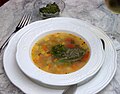 Soup au Pistou
 -
 Marmite
 -
 Vegemite
 -
 Marmite Returns to New Zealand
 -
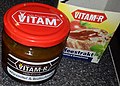 A jar of Vitam-R yeast paste
 -
 Cenovis


.jpg)


