Sugar people: Difference between revisions
CSV import Tags: mobile edit mobile web edit |
CSV import |
||
| Line 27: | Line 27: | ||
[[Category:Sugar]] | [[Category:Sugar]] | ||
{{food-stub}} | {{food-stub}} | ||
<gallery> | |||
File:Chinese_candies.jpg|Chinese candies | |||
File:Ctr1.jpg|Sugar_people | |||
File:Chuitangren.JPG|Chuitangren | |||
</gallery> | |||
Latest revision as of 01:17, 18 February 2025
Sugar People are a cultural phenomenon that originated from the tradition of creating human-like figures out of sugar. This practice has roots in various cultures and has evolved over time, becoming a significant part of celebrations, rituals, and art.
History[edit]
The history of Sugar People dates back to ancient times. In Ancient Egypt, sugar was used to create figures for religious rituals. Similarly, in Medieval Europe, sugar sculptures were a common feature at banquets of the nobility. These sculptures often took the form of people, animals, and mythical creatures.
Cultural Significance[edit]
Sugar People hold a significant place in various cultures. In Mexico, sugar skulls, known as calaveras, are made for the Day of the Dead celebration. These are not typically in the shape of people, but they are a related form of sugar art. In China, during the Qingming Festival, people make and display sugar figures, including human forms, as a way to honor their ancestors.
Production[edit]
The production of Sugar People involves the use of granulated sugar, water, and sometimes additional ingredients like corn syrup or lemon juice. The mixture is heated until it reaches a certain temperature, then it is molded into the desired shape. The figures are often decorated with colored sugar or icing.
Modern Usage[edit]
Today, Sugar People are often used as cake toppers or decorations for other desserts. They are also popular as a form of edible art, with artists creating intricate and detailed sugar sculptures.
See Also[edit]

-
 Chinese candies
 -
 Sugar_people
 -
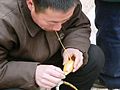 Chuitangren


