Onsen tamago: Difference between revisions
CSV import |
CSV import |
||
| Line 25: | Line 25: | ||
{{Japanese-food-stub}} | {{Japanese-food-stub}} | ||
{{food-stub}} | {{food-stub}} | ||
<gallery> | |||
File:Onsen_tamago_at_minshuku_Korakuen,_Nagano_by_Blue_Lotus.jpg|Onsen tamago at Minshuku Korakuen, Nagano | |||
</gallery> | |||
Latest revision as of 00:58, 17 February 2025
Onsen Tamago is a traditional Japanese low-temperature egg which is originally slow-cooked in the water of Onsen (hot springs) in Japan. The egg has a unique texture, with a soft, custard-like yolk and a white that remains slightly runny even after cooking.
History[edit]
The history of Onsen Tamago dates back to the Edo period in Japan, when people discovered that eggs could be slow-cooked in the naturally hot water of Onsen. The method of cooking was unique to Japan and became popular due to the distinctive texture and flavor of the eggs.
Preparation[edit]
The preparation of Onsen Tamago involves slow-cooking eggs at a low temperature. Traditionally, the eggs are placed in a net and left in the hot spring water for a certain period of time. The temperature of the water is usually around 70 degrees Celsius, which is lower than the boiling point of water. This allows the eggs to cook slowly and evenly, resulting in a soft, custard-like yolk and a slightly runny white.
In modern times, Onsen Tamago can also be prepared at home using a method known as the Sous-vide technique. This involves placing the eggs in a water bath and maintaining a constant temperature to achieve the same effect as cooking in a hot spring.
Serving[edit]
Onsen Tamago is typically served as a breakfast dish in Japan, but it can also be enjoyed as a snack or a side dish. It is often served with a soy-based sauce and can be eaten on its own or with rice.
Cultural Significance[edit]
Onsen Tamago is not just a food item, but also a symbol of the Japanese culture and tradition. It represents the Japanese appreciation for natural resources and their ability to utilize them in their daily life. The dish is also a testament to the Japanese culinary tradition of simplicity and minimalism, where the natural flavors of the ingredients are highlighted.
See Also[edit]

-
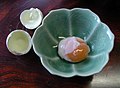 Onsen tamago at Minshuku Korakuen, Nagano

