Pecten maximus: Difference between revisions
CSV import Tags: mobile edit mobile web edit |
CSV import |
||
| Line 24: | Line 24: | ||
{{Bivalve-stub}} | {{Bivalve-stub}} | ||
{{food-stub}} | {{food-stub}} | ||
<gallery> | |||
File:Pecten_maximus_Pilgermuschel.jpg|Pecten maximus | |||
File:Pecten_maximus_01.jpg|Pecten maximus | |||
File:Pecten_maximus_02.jpg|Pecten maximus | |||
File:Pecten_maximus_03.jpg|Pecten maximus | |||
File:Pecten_maximus_04.jpg|Pecten maximus | |||
File:Pecten_maximus(02).jpg|Pecten maximus | |||
File:Yeux_et_tentacules_d'une_coquille_Saint-Jacques_(Pecten_maximus)_(Ifremer_00570-68227_-_49129).jpg|Eyes and tentacles of a scallop (Pecten maximus) | |||
File:Great_atlantic_scallop,_capture_production,_thousand_tonnes,_1950-2022.svg|Great Atlantic scallop capture production, thousand tonnes, 1950-2022 | |||
</gallery> | |||
Revision as of 12:09, 18 February 2025
Pecten maximus, commonly known as the Great Scallop or King Scallop, is a species of scallop, a type of marine bivalve mollusk in the family Pectinidae. This species is native to the northeastern Atlantic Ocean, specifically from the north coast of Norway to the Iberian Peninsula.
Description
The Great Scallop can grow up to 17 cm in size, making it one of the largest scallop species. It has a fan-shaped shell with radiating ribs and a slightly wavy edge. The upper shell is usually reddish-brown, while the lower shell is pale or white.
Habitat and Distribution
Pecten maximus is found in the northeastern Atlantic Ocean, from the north coast of Norway to the Iberian Peninsula. It inhabits a variety of habitats, from sheltered bays to exposed coasts, and from the intertidal zone to depths of up to 100 meters.
Diet
The diet of Pecten maximus consists mainly of plankton, which it filters from the water using its gills.
Reproduction
The Great Scallop is a hermaphrodite, meaning each individual has both male and female reproductive organs. Spawning usually occurs in summer, and the larvae are planktonic.
Economic Importance
Pecten maximus is commercially important and is harvested for its meat. It is a popular seafood in many parts of Europe, particularly in France, where it is a key ingredient in dishes such as Coquilles Saint-Jacques.
Conservation
While Pecten maximus is not currently considered threatened, it is vulnerable to overfishing and habitat degradation. Conservation measures include size limits and restrictions on harvesting during the breeding season.


-
 Pecten maximus
 -
 Pecten maximus
 -
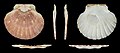 Pecten maximus
 -
 Pecten maximus
 -
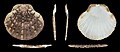 Pecten maximus
 -
 Pecten maximus
 -
 Eyes and tentacles of a scallop (Pecten maximus)
 -
 Great Atlantic scallop capture production, thousand tonnes, 1950-2022


.jpg)
_(Ifremer_00570-68227_-_49129).jpg)

