Humboldt squid: Difference between revisions
CSV import |
CSV import |
||
| Line 32: | Line 32: | ||
{{Cephalopod-stub}} | {{Cephalopod-stub}} | ||
{{food-stub}} | {{food-stub}} | ||
<gallery> | |||
File:Sanc1686_-_Flickr_-_NOAA_Photo_Library.jpg|Humboldt squid | |||
File:Deadsquid.JPG|Humboldt squid | |||
File:Dosidicus_gigas2.jpg|Humboldt squid | |||
File:Dosidicus_gigas_1.jpg|Humboldt squid | |||
File:Giant_Homboldt_squid.jpg|Humboldt squid | |||
File:Jumbo_flying_squid_capture_production_million_tonnes_1980-2022.svg|Humboldt squid | |||
File:Squid_steaks,_uncooked.jpg|Humboldt squid | |||
</gallery> | |||
Latest revision as of 11:13, 18 February 2025
Humboldt Squid (Dosidicus gigas), also known as the jumbo squid or jumbo flying squid, is a large, predatory squid living in the waters of the Humboldt Current in the eastern Pacific Ocean.
Description[edit]
The Humboldt squid is a robust and strong swimmer, with a body size that can reach up to 1.5 meters (4.9 ft) in mantle length and weigh up to 50 kilograms (110 lb). The squid's body is soft and gelatinous, yet muscular, and it is covered in a skin that can change color and pattern in a flash, a feature that is common among cephalopods.
Behavior[edit]
Humboldt squids are known for their aggressive behavior and have been known to rapidly change their body coloration, a behavior thought to be a complex form of communication among this species. They are also known for their ability to 'fly' out of the water, a behavior that is thought to be a method of evading predators.
Diet[edit]
The diet of the Humboldt squid is varied and includes a wide range of deep-sea fish and other squids. They are also known to exhibit cannibalistic behavior.
Distribution and habitat[edit]
The Humboldt squid is found in the eastern Pacific Ocean, particularly in the Humboldt Current, which flows northward along the west coast of South America. They are typically found at depths of 200 to 700 meters (660 to 2,300 ft), but have been recorded at depths of up to 1,500 meters (4,900 ft).
Human interaction[edit]
Humboldt squids are of significant interest to commercial fisheries. They are caught in large numbers off the coasts of California, Mexico, and South America. Despite their reputation for aggression, attacks on humans are rare.
Conservation status[edit]
The conservation status of the Humboldt squid is currently not evaluated by the International Union for Conservation of Nature (IUCN).
See also[edit]
References[edit]
<references />

This article is a cephalopod-related stub. You can help WikiMD by expanding it!

-
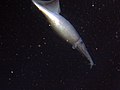 Humboldt squid
 -
 Humboldt squid
 -
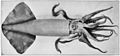 Humboldt squid
 -
 Humboldt squid
 -
 Humboldt squid
 -
 Humboldt squid
 -
Humboldt squid


