Malay cuisine: Difference between revisions
CSV import Tags: mobile edit mobile web edit |
CSV import |
||
| Line 32: | Line 32: | ||
{{Asian-cuisine-stub}} | {{Asian-cuisine-stub}} | ||
{{food-stub}} | {{food-stub}} | ||
<gallery> | |||
File:Nasi_Lemak_Sambal_Cumi_in_Indonesia_2.jpg|Malay cuisine | |||
File:RayaHajiFood.PNG|Malay cuisine | |||
File:Tempoyak_Ikan_Patin_2.JPG|Malay cuisine | |||
File:Ambuyat_in_Bandar_Seri_Begawan_Brunei.jpg|Malay cuisine | |||
File:Otak-otak_Jakarta.JPG|Malay cuisine | |||
File:Shrimp.paste-Sambal.Belacan-01.jpg|Malay cuisine | |||
File:Bandung_Drinks.jpg|Malay cuisine | |||
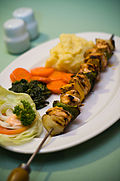
File:Chicken_sosatie.jpg|Malay cuisine | |||
File:Bobootie_2.JPG|Malay cuisine | |||
File:Ikan_Asam_Pedas_Mempawah.jpg|Malay cuisine | |||
File:Spaghetti_with_Ayam_masak_merah.jpg|Malay cuisine | |||
File:YosriAyamGolek.jpg|Malay cuisine | |||
</gallery> | |||
Latest revision as of 12:10, 18 February 2025
Malay cuisine is a type of Southeast Asian cuisine that originates from the Malay people. It is known for its vibrant and diverse flavors, which are influenced by a variety of cultures and traditions. Malay cuisine is characterized by its extensive use of spices, coconut milk, and other indigenous ingredients.
History[edit]
The history of Malay cuisine dates back to the Malay Peninsula's early inhabitants, who were skilled in foraging for edible plants and hunting for food. The cuisine evolved over time, incorporating influences from Indian, Chinese, and Arab traders, as well as European colonizers.
Ingredients[edit]
Common ingredients in Malay cuisine include rice, coconut milk, palm sugar, and a variety of spices such as turmeric, coriander, lemongrass, and chili peppers. Seafood, particularly fish, is also a staple in Malay cuisine due to the region's coastal geography.
Dishes[edit]
Some popular Malay dishes include Nasi Lemak, a fragrant rice dish cooked in coconut milk and pandan leaf, and Satay, skewered and grilled meat served with a peanut sauce. Another well-known dish is Rendang, a spicy meat dish that is slow-cooked in coconut milk and a mixture of lemongrass, galangal, and turmeric.
Cooking Techniques[edit]
Malay cooking techniques are diverse and reflect the cuisine's rich history. These include grilling (Satay), stir-frying (Char Kway Teow), and slow-cooking (Rendang). Many dishes also involve the use of a pestle and mortar to grind spices into a paste.
Cultural Significance[edit]
Food plays a significant role in Malay culture and traditions. It is often the centerpiece of celebrations and gatherings, and many dishes have symbolic meanings. For example, Nasi Lemak is often eaten for breakfast to symbolize a prosperous start to the day.
See Also[edit]

-
 Malay cuisine
 -
 Malay cuisine
 -
 Malay cuisine
 -
 Malay cuisine
 -
 Malay cuisine
 -
 Malay cuisine
 -
 Malay cuisine
 -
 Malay cuisine
 -
 Malay cuisine
 -
 Malay cuisine
 -
 Malay cuisine
 -
 Malay cuisine


