Garum: Difference between revisions
CSV import |
CSV import |
||
| Line 23: | Line 23: | ||
[[Category:Fermented foods]] | [[Category:Fermented foods]] | ||
{{food-stub}} | {{food-stub}} | ||
<gallery> | |||
File:Garumamphoren.JPG|Amphorae used for storing garum | |||
File:Factoría_de_salazones_001.jpg|Ancient fish salting factory | |||
File:Fábrica_romana_de_Salga_05.jpg|Roman fish processing factory | |||
File:Garum_Mosaik_Pompeji.JPG|Mosaic depicting garum from Pompeii | |||
</gallery> | |||
Latest revision as of 04:37, 18 February 2025
Garum was a fermented fish sauce used as a condiment in the cuisines of ancient Greece, Rome, and Byzantium. Its use in the Mediterranean world once surpassed that of salt alone and it reached its zenith during the Roman Empire. The sauce was often used as a cooking or table condiment to be added to dishes for flavor.
History[edit]
The origins of Garum are not well-documented. It is believed to have been first used by the Ancient Greeks, who called it garos or garon. The Romans, who later adopted the sauce, referred to it as Garum. The production of Garum was a significant economic activity in the Roman Empire, with factories established in many coastal cities.
Production[edit]
Garum was made from the intestines of small fish, such as anchovies, along with salt and various spices. The mixture was left to ferment in the sun for several weeks, during which time it was regularly stirred to encourage the breakdown of the fish. The resulting liquid was then strained and bottled.
Use[edit]
Garum was used in a variety of dishes in ancient Rome, including stews, soups, and sauces. It was also used as a table condiment, much like modern soy sauce or ketchup. Despite its popularity, Garum was often criticized by contemporary authors for its strong smell.
Legacy[edit]
The use of Garum declined with the fall of the Roman Empire, but it has seen a resurgence in recent years among chefs and food enthusiasts interested in historical cooking techniques. Modern versions of Garum are often made using more palatable ingredients, such as anchovies, and are used in a similar manner to the original sauce.
See also[edit]

-
 Amphorae used for storing garum
 -
 Ancient fish salting factory
 -
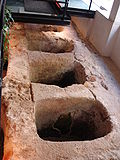 Roman fish processing factory
 -
 Mosaic depicting garum from Pompeii


