Orca: Difference between revisions
CSV import |
CSV import |
||
| Line 30: | Line 30: | ||
[[Category:Articles with 'species' microformats]] | [[Category:Articles with 'species' microformats]] | ||
{{stub}} | {{stub}} | ||
== Orca gallery == | |||
<gallery> | |||
File:Killerwhales jumping.jpg|Killer whales jumping | |||
File:Female orca scale.png|Female orca scale | |||
File:Naturalis Biodiversity Center - Museum - Workshop - Lecture hall, killer whale skeleton suspended from ceiling2.jpg|Killer whale skeleton suspended from ceiling | |||
File:Typical killer whale markings.png|Typical killer whale markings | |||
File:Antarctic Killer Whale Types.png|Antarctic killer whale types | |||
File:Killer Whale chasing Chinook.jpg|Killer whale chasing Chinook | |||
File:KW attack STBW.jpg|KW attack STBW | |||
File:Killer Whales Hunting a Crabeater Seal.jpg|Killer whales hunting a crabeater seal | |||
File:Transient Orcas (3727711709).jpg|Transient orcas | |||
File:091201 south georgia orca 5227 (4173390858).jpg|South Georgia orca | |||
</gallery> | |||
Revision as of 05:00, 3 March 2025
Orca or Killer Whale (Orcinus orca) is a toothed whale belonging to the oceanic dolphin family, of which it is the largest member.
Description
Killer whales have a diverse diet, although individual populations often specialize in particular types of prey. Some feed exclusively on fish, while others hunt marine mammals such as seals and other species of dolphin. They have been known to attack baleen whale calves, and even adult whales. Killer whales are apex predators, as no animal preys on them.
Behavior
Killer whales are highly social; some populations are composed of matrilineal family groups (pods) which are the most stable of any animal species. Their sophisticated hunting techniques and vocal behaviors, which are often specific to a particular group and passed across generations, have been described as manifestations of animal culture.
Distribution
The killer whale's sophisticated hunting techniques and vocal behaviors, which are often specific to a particular group and passed across generations, have been described as manifestations of animal culture. They are found in oceans all over the world, particularly in the colder waters of the Arctic and Antarctic.
Conservation
Killer whales are not considered a threat to humans, but there have been cases of captive orcas killing or injuring their handlers at marine theme parks. Killer whales feature strongly in the mythologies of indigenous cultures, with their reputation ranging from being the souls of humans to merciless killers.
See also
References
<references />
External links
 | |
|---|---|
 |
 |
Orca gallery
-
 Killer whales jumping
 -
 Female orca scale
 -
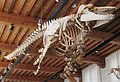 Killer whale skeleton suspended from ceiling
 -
 Typical killer whale markings
 -
 Antarctic killer whale types
 -
 Killer whale chasing Chinook
 -
 KW attack STBW
 -
 Killer whales hunting a crabeater seal
 -
 Transient orcas
 -
 South Georgia orca


.jpg)
.jpg)
