Posterior cruciate ligament: Difference between revisions
CSV import |
CSV import |
||
| Line 29: | Line 29: | ||
{{stub}} | {{stub}} | ||
<gallery> | |||
File:Knee_diagram.svg|Diagram of the knee joint | |||
File:PCL_Extension_and_Hyperextension.png|PCL during extension and hyperextension | |||
File:Gray348-2.png|Anatomy of the knee joint | |||
File:PCL_Flexion_and_Hyperflexion.png|PCL during flexion and hyperflexion | |||
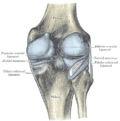
File:Gray349.png|Ligaments of the knee | |||
File:Gray352.png|Sagittal section of the knee joint | |||
File:MRT_ACL_PCL_01.jpg|MRI of ACL and PCL | |||
File:Slide2CAC.JPG|Posterior cruciate ligament | |||
File:Slide3ecce.JPG|Posterior cruciate ligament | |||
</gallery> | |||
Latest revision as of 11:25, 18 February 2025
Posterior Cruciate Ligament
The Posterior Cruciate Ligament (PCL) is one of the four major ligaments of the knee. It originates from the posterior intercondylar area of the tibia and inserts into the medial condyle of the femur. This ligament is responsible for preventing the tibia from sliding backwards under the femur.
Anatomy[edit]
The PCL is located within the knee. It connects the femur to the tibia. The ligament is named for its posterior insertion on the tibial plateau.
Function[edit]
The primary functions of the PCL is to prevent posterior translation of the tibia on the femur. The PCL is also important in controlling the amount of tibial external and internal rotation.
Clinical significance[edit]
Injury to the PCL can occur as a result of direct impact, such as in an automobile accident, or during sports when an athlete falls on a bent knee with the foot pointed down. The ligament can also be injured by a direct blow to the front of the knee.
Treatment[edit]
Treatment for PCL injuries includes rest, ice, and elevation. Nonsteroidal anti-inflammatory drugs (NSAIDs) may also be used to help reduce pain and swelling. In severe cases, surgery may be required to repair or reconstruct the PCL.
See also[edit]
 | |
|---|---|
 |
 |
-
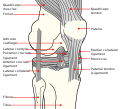 Diagram of the knee joint
 -
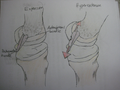 PCL during extension and hyperextension
 -
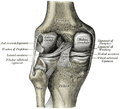 Anatomy of the knee joint
 -
 PCL during flexion and hyperflexion
 -
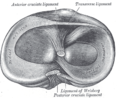 Ligaments of the knee
 -
 Sagittal section of the knee joint
 -
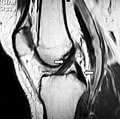 MRI of ACL and PCL
 -
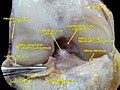 Posterior cruciate ligament
 -
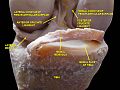 Posterior cruciate ligament


