Sulfuric acid: Difference between revisions
CSV import |
CSV import |
||
| Line 23: | Line 23: | ||
{{stub}} | {{stub}} | ||
<gallery> | |||
File:Sulphuric_acid_96_percent_extra_pure.jpg|Sulphuric acid 96 percent extra pure | |||
File:Sulfuric_acid.svg|Sulfuric acid | |||
File:07._Дехидратациони_својства_на_концентрирана_сулфурна_киселина.webm|Dehydration properties of concentrated sulfuric acid | |||
File:Sulphuric_acid_on_a_piece_of_towel.JPG|Sulphuric acid on a piece of towel | |||
File:Structure_of_protonated_sulfuric_acid.png|Structure of protonated sulfuric acid | |||
File:Benzene_sulfonaition.svg|Benzene sulfonation | |||
File:Rio_tinto_river_CarolStoker_NASA_Ames_Research_Center.jpg|Rio Tinto river | |||
File:Sulfuric_acid_2000.png|Sulfuric acid 2000 | |||
File:Acidic_drain_cleaner_containing_sulfuric_acid_(sulphuric_acid).jpg|Acidic drain cleaner containing sulfuric acid | |||
File:Acidic_drain_opener.JPG|Acidic drain opener | |||
File:Dalton's-sulphuric-acid.jpg|Dalton's sulfuric acid | |||
File:Sulfuric_acid_burning_tissue_paper.jpg|Sulfuric acid burning tissue paper | |||
</gallery> | |||
Latest revision as of 21:38, 23 February 2025
Sulfuric acid (American spelling) or sulphuric acid (British spelling), also known as oil of vitriol, is a mineral acid composed of the elements sulfur, oxygen and hydrogen, with molecular formula H2SO4. It is a colorless, odorless, and syrupy liquid that is soluble in water, in a reaction that is highly exothermic.
Properties[edit]
Sulfuric acid is a very strong acid and in aqueous solutions it ionizes completely to form hydronium ions (H3O+) and hydrogen sulfate ions (HSO4-). If a strong enough concentration is present, it can also ionize the hydrogen sulfate ions to form hydronium ions and sulfate ions (SO42-).
Production[edit]
Sulfuric acid is produced from sulfur, oxygen and water via the contact process. In the first step, sulfur is burned to produce sulfur dioxide. This is then oxidized to sulfur trioxide using oxygen in the presence of a vanadium(V) oxide catalyst. Finally, the sulfur trioxide is treated with water to produce sulfuric acid.
Uses[edit]
Sulfuric acid has many applications, and is one of the top products of the chemical industry. Primary uses for sulfuric acid include lead-acid batteries for cars and other vehicles, ore processing, fertilizer manufacturing, oil refining, wastewater processing, and chemical synthesis.
Safety[edit]
Contact with sulfuric acid can cause burns, permanent blindness if it contacts eyes, and can be fatal if swallowed or inhaled. Appropriate safety measures should be taken when handling sulfuric acid.
See also[edit]
 | |
|---|---|
 |
 |
-
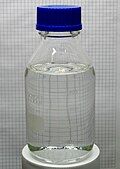 Sulphuric acid 96 percent extra pure
 -
 Sulfuric acid
 -
 Dehydration properties of concentrated sulfuric acid
 -
 Sulphuric acid on a piece of towel
 -
 Structure of protonated sulfuric acid
 -
 Benzene sulfonation
 -
 Rio Tinto river
 -
 Sulfuric acid 2000
 -
 Acidic drain cleaner containing sulfuric acid
 -
 Acidic drain opener
 -
 Dalton's sulfuric acid
 -
 Sulfuric acid burning tissue paper


.jpg)


