Ribosome: Difference between revisions
CSV import Tags: mobile edit mobile web edit |
CSV import |
||
| Line 37: | Line 37: | ||
{{Cell-biology-stub}} | {{Cell-biology-stub}} | ||
{{Molecular-biology-stub}} | {{Molecular-biology-stub}} | ||
== Ribosome == | |||
<gallery> | |||
File:ribosome_shape.png|Ribosome shape | |||
File:Peptide_syn.svg|Peptide synthesis | |||
File:Ribosome_Structure.png|Ribosome structure | |||
File:010_small_subunit-1FKA.gif|Small subunit 1FKA | |||
File:10_large_subunit.gif|Large subunit | |||
File:Ribosomer_i_arbete.png|Ribosome in action | |||
File:Protein_translation.gif|Protein translation | |||
</gallery> | |||
Latest revision as of 21:17, 23 February 2025
Ribosome
The Ribosome is a complex molecular machine, found within all living cells, that serves as the site of biological protein synthesis (translation). Ribosomes link amino acids together in the order specified by messenger RNA (mRNA) molecules. Ribosomes consist of two major components: the small ribosomal subunits, which read the RNA, and the large subunits, which join amino acids to form a polypeptide chain. Each subunit consists of one or more ribosomal RNA (rRNA) molecules and a variety of ribosomal proteins (r-proteins).
Structure[edit]
Ribosomes are composed of two subunits that fit together and work as one to translate the mRNA into a polypeptide chain during protein synthesis. Because they are formed from two subunits of non-equal size, they are slightly longer in the axis than in diameter.
Prokaryotic Ribosomes[edit]
Prokaryotic ribosomes are around 20 nm (200 Å) in diameter and are composed of 65% rRNA and 35% ribosomal proteins. Because of their size, they are slightly smaller than eukaryotic ribosomes.
Eukaryotic Ribosomes[edit]
Eukaryotic ribosomes are between 25 and 30 nm (250–300 Å) in diameter with an rRNA to protein ratio that is close to 1. Eukaryotic ribosomes are larger than prokaryotic ribosomes, and their differences in size and composition are largely due to an increased protein content.
Function[edit]
The primary function of ribosomes is to synthesize proteins. Ribosomes do this by assembling amino acids into polypeptide chains. This process is known as translation.
See also[edit]
References[edit]
<references />

This article is a cell biology stub. You can help WikiMD by expanding it!

This article is a molecular biology stub. You can help WikiMD by expanding it!
Ribosome[edit]
-
 Ribosome shape
 -
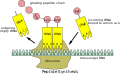 Peptide synthesis
 -
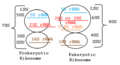 Ribosome structure
 -
 Small subunit 1FKA
 -
Large subunit
-
Ribosome in action
-
Protein translation


