Wasp: Difference between revisions
CSV import |
CSV import |
||
| Line 31: | Line 31: | ||
{{stub}} | {{stub}} | ||
<gallery> | |||
File:Vespula_germanica_Richard_Bartz.jpg|Vespula germanica | |||
File:Wasps_are_Paraphyletic.svg|Wasps are Paraphyletic | |||
File:Neotype_male_of_Electrostephanus_petiolatus_Brues_in_Baltic_amber_(AMNH_B-JWJ-260).png|Neotype male of Electrostephanus petiolatus in Baltic amber | |||
File:Indian_yellow_wasp.jpg|Indian yellow wasp | |||
File:Megascolia_procer_MHNT_dos.jpg|Megascolia procer | |||
File:Ichneumon_wasp_(Megarhyssa_macrurus_lunato)_(7686081848).jpg|Ichneumon wasp (Megarhyssa macrurus lunato) | |||
File:Wasp_with_Orange-kneed_tarantula.JPG|Wasp with Orange-kneed tarantula | |||
File:Active_Wasp_Nest.jpg|Active Wasp Nest | |||
File:Potter_Wasp_building_mud_nest_near_completion.JPG|Potter Wasp building mud nest near completion | |||
File:Vespa_crabro09(js),_Lodz(Poland).jpg|Vespa crabro | |||
File:Wasp_August_2007-23.jpg|Wasp August 2007 | |||
File:IndianSpiderWasp.JPG|Indian Spider Wasp | |||
</gallery> | |||
Latest revision as of 21:39, 23 February 2025
Wasp is a term used to describe a diverse group of insects in the order Hymenoptera. They are known for their distinctive appearance, which often includes bright colors and a narrow waist, and their ability to sting. Wasps can be found all over the world and play a crucial role in ecosystems as predators, pollinators, and parasitoids.
Classification and diversity[edit]
Wasps belong to the order Hymenoptera, which also includes ants and bees. There are over 30,000 known species of wasps, which are divided into two main groups: the Apoideans, which include bees and wasps that are bee-like in appearance, and the Vespoids, which include the more typical wasps.
Anatomy and appearance[edit]
Wasps have a distinctive appearance that includes a narrow waist (or "petiole") that separates the thorax from the abdomen. They also have two pairs of wings, with the larger forewings covering the smaller hind wings when at rest. Wasps are often brightly colored, with many species having yellow and black markings.
Behavior and ecology[edit]
Wasps play a crucial role in ecosystems as predators, pollinators, and parasitoids. Many species are solitary, but there are also many species that are social and live in colonies. Some wasps are known for their aggressive behavior when threatened.
Human interaction[edit]
While wasps are often viewed as pests due to their ability to sting, they are also beneficial to humans in many ways. They help control pest insect populations, and some species are used in agriculture for biological pest control. Some wasps are also pollinators, helping to pollinate crops and other plants.
See also[edit]
References[edit]
<references />
 | |
|---|---|
 |
 |
-
 Vespula germanica
 -
 Wasps are Paraphyletic
 -
 Neotype male of Electrostephanus petiolatus in Baltic amber
 -
 Indian yellow wasp
 -
 Megascolia procer
 -
 Ichneumon wasp (Megarhyssa macrurus lunato)
 -
 Wasp with Orange-kneed tarantula
 -
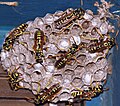 Active Wasp Nest
 -
 Potter Wasp building mud nest near completion
 -
 Vespa crabro
 -
 Wasp August 2007
 -
 Indian Spider Wasp


.png)


_(7686081848).jpg)


,_Lodz(Poland).jpg)


