Quartz: Difference between revisions
CSV import |
CSV import |
||
| Line 24: | Line 24: | ||
{{stub}} | {{stub}} | ||
== Quartz == | |||
<gallery> | |||
File:Quartz_Brésil.jpg|Quartz Brésil | |||
File:Α-Quartz.svg|Α-Quartz | |||
File:Β-Quartz.svg|Β-Quartz | |||
File:Alpha-quartz,_P3_121_and_P3_221.png|Alpha-quartz, P3 121 and P3 221 | |||
File:00026_40_mm_quartz.jpg|40 mm quartz | |||
File:Améthyste,_quartz_300-3-7640.JPG|Améthyste quartz | |||
File:Quartz_sceptres_fumés_sur_quartz_(Madagascar)_1.jpg|Quartz sceptres fumés sur quartz (Madagascar) | |||
File:Quartz-314899.jpg|Quartz 314899 | |||
File:Quartz-197980.jpg|Quartz 197980 | |||
File:Hyaline_quartz-MCG-NM-IMG_7481-black.jpg|Hyaline quartz | |||
File:Quartz_sur_quartz_7(Brésil).jpg|Quartz sur quartz (Brésil) | |||
File:Herkimer.jpg|Herkimer | |||
</gallery> | |||
Latest revision as of 21:07, 23 February 2025
Quartz is a hard, crystalline mineral composed of silicon and oxygen atoms. The atoms are linked in a continuous framework of SiO4 silicon-oxygen tetrahedra, with each oxygen being shared between two tetrahedra, giving an overall chemical formula of SiO2. Quartz is the second most abundant mineral in Earth's continental crust, behind feldspar.
Properties[edit]
Quartz belongs to the trigonal crystal system. The ideal crystal shape is a six-sided prism terminating with six-sided pyramids at each end. In nature quartz crystals are often twinned, distorted, or so intergrown with adjacent crystals of quartz or other minerals as to only show part of this shape, or to lack obvious crystal faces altogether and appear massive.
Varieties[edit]
Pure quartz, traditionally called rock crystal or clear quartz, is colorless and transparent or translucent, and has often been used for hardstone carvings, such as the Lothair Crystal. Common colored varieties include citrine, rose quartz, amethyst, smoky quartz, milky quartz, and others.
Occurrence[edit]
Quartz is a defining constituent of granite and other felsic igneous rocks. It is very common in sedimentary rocks such as sandstone and shale. It is a common constituent of schist, gneiss, quartzite and other metamorphic rocks.
Uses[edit]
Quartz is used for a vast array of applications. It is used in the manufacture of glass and ceramics, silicon carbide, and cement; it is also used in building construction and electronics, and it is an important raw material for the manufacture of silicon.
See also[edit]
 | |
|---|---|
 |
 |
Quartz[edit]
-
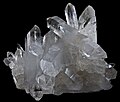 Quartz Brésil
 -
 Α-Quartz
 -
 Β-Quartz
 -
 Alpha-quartz, P3 121 and P3 221
 -
 40 mm quartz
 -
 Améthyste quartz
 -
 Quartz sceptres fumés sur quartz (Madagascar)
 -
 Quartz 314899
 -
 Quartz 197980
 -
 Hyaline quartz
 -
 Quartz sur quartz (Brésil)
 -
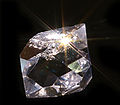 Herkimer


_1.jpg)


.jpg)

