Pyrolysis: Difference between revisions
CSV import Tags: mobile edit mobile web edit |
CSV import Tags: mobile edit mobile web edit |
||
| Line 33: | Line 33: | ||
{{stub}} | {{stub}} | ||
== Pyrolysis == | |||
<gallery> | |||
File:Fire_1873.JPG|Fire 1873 | |||
File:JapaneseOakCharcoal_KuroSumi.jpg|Japanese Oak Charcoal Kuro Sumi | |||
File:Processes_in_the_thermal_degredation_of_organic_matter.svg|Processes in the thermal degradation of organic matter | |||
File:Caramelisation_of_carrots.jpg|Caramelisation of carrots | |||
File:Verkohlte_Pizza_2013-04-01-2658.jpg|Verkohlte Pizza 2013-04-01 | |||
File:BurningOgatan(JapaneseBriquetteCharcoal).theora.ogv|Burning Ogatan (Japanese Briquette Charcoal) | |||
File:Coal-forge-diagram.svg|Coal forge diagram | |||
File:CoalPyrolysisProducts.png|Coal Pyrolysis Products | |||
File:Carbon_fibers_from_silk_cocoon.tif|Carbon fibers from silk cocoon | |||
File:Methane_Pyrolysis-1.png|Methane Pyrolysis 1 | |||
File:MOCVD_process.svg|MOCVD process | |||
File:Pyrolysis.svg|Pyrolysis | |||
</gallery> | |||
Latest revision as of 21:02, 23 February 2025
Pyrolysis is a thermochemical decomposition of organic material at elevated temperatures in the absence of oxygen (or any halogen). It involves the simultaneous change of chemical composition and physical phase, and is irreversible. The word is coined from the Greek-derived elements pyro "fire" and lysis "separating".
Pyrolysis is a type of thermolytic process, which includes combustion and other methods of breaking down substances by heat. Pyrolysis is most commonly used in the treatment of organic materials. It is one of the processes involved in charring wood, starting at 200–300 °C (392–572 °F). It is also extensively used in the production of charcoal, methanol and other chemicals from wood and other organic substances.
Process[edit]
In general, pyrolysis of organic substances produces gas and liquid products and leaves a solid residue richer in carbon content. Extreme pyrolysis, which leaves mostly carbon as the residue, is called carbonization.
The process is used heavily in the chemical industry, for example, to produce ethylene, propylene, and other olefins from naphtha; to produce BTX aromatics (benzene, toluene, and xylene) from heavy aromatics by dealkylation; to enhance the octane rating of oil; to convert triglycerides into non-esterified fatty acids and glycerol; and to turn waste into safely disposable substances. It also plays an important role in the production of beads, fibers, and engineering resins.
Applications[edit]
Pyrolysis has many applications in food preparation. For example, it is used to caramelize food and create a desirable flavor in some food products. Pyrolysis also plays an essential role in several cooking procedures, such as baking, frying, grilling, and caramelizing.
In analytical chemistry, pyrolysis is used for preparing samples for analysis. It is also significant in the field of environmental science for this reason.
See also[edit]
References[edit]
<references />
 | |
|---|---|
 |
 |
Pyrolysis[edit]
-
 Fire 1873
 -
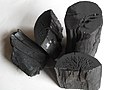 Japanese Oak Charcoal Kuro Sumi
 -
 Processes in the thermal degradation of organic matter
 -
 Caramelisation of carrots
 -
 Verkohlte Pizza 2013-04-01
 -
 Burning Ogatan (Japanese Briquette Charcoal)
 -
 Coal forge diagram
 -
 Coal Pyrolysis Products
 -
 Carbon fibers from silk cocoon
 -
 Methane Pyrolysis 1
 -
 MOCVD process
 -
 Pyrolysis


