Rolling circle replication: Difference between revisions
CSV import |
CSV import |
||
| Line 22: | Line 22: | ||
{{stub}} | {{stub}} | ||
<gallery> | |||
File:Rolling_circle.svg|Rolling circle | |||
File:Rolling-circle_replication.png|Rolling-circle replication | |||
File:Rolling_Circle_Replication_Virology.jpg|Rolling Circle Replication Virology | |||
File:Rolling_circle_replication_of_RNA_viroids.jpg|Rolling circle replication of RNA viroids | |||
File:Rolling_circle_amplification_mechanism.jpg|Rolling circle amplification mechanism | |||
File:Rolling_circle_amplification_detection.jpg|Rolling circle amplification detection | |||
File:Wiki_fig2.png|Wiki fig2 | |||
File:Illustration_of_aptamer_based_immuno-rca.png|Illustration of aptamer based immuno-rca | |||
</gallery> | |||
Latest revision as of 21:12, 23 February 2025
Rolling circle replication is a process of unidirectional nucleic acid replication that can rapidly synthesize multiple copies of circular molecules of DNA or RNA, such as plasmids, the genomes of bacteriophages, and the circular RNA genome of viroids. Some eukaryotic viruses also replicate their DNA via a rolling circle mechanism.
Mechanism[edit]
The mechanism of rolling circle replication begins with a break in one of the nucleotide strands in the circular DNA molecule. This break allows for the 3' end of the broken strand to serve as a primer for DNA polymerase. The DNA polymerase then synthesizes a new strand of DNA in the 5' to 3' direction, displacing the original, unbroken strand as it progresses. The unbroken strand is simultaneously replicated, with the newly synthesized strand serving as a template. This results in a "rolling circle" of DNA synthesis, producing multiple tandem copies of the original DNA sequence.
Applications[edit]
Rolling circle replication is used in nature by various viruses, plasmids, and bacteria to rapidly replicate their genetic material. It is also used in laboratory settings for the amplification of certain types of DNA, such as in the Rolling Circle Amplification (RCA) technique. RCA is a simple, isothermal enzymatic process used for the detection of specific DNA and RNA sequences.
See also[edit]
References[edit]
<references />
 | |
|---|---|
 |
 |
-
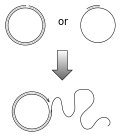 Rolling circle
 -
 Rolling-circle replication
 -
 Rolling Circle Replication Virology
 -
 Rolling circle replication of RNA viroids
 -
 Rolling circle amplification mechanism
 -
 Rolling circle amplification detection
 -
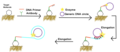 Wiki fig2
 -
 Illustration of aptamer based immuno-rca


