Weightlessness: Difference between revisions
CSV import Tags: mobile edit mobile web edit |
CSV import Tags: mobile edit mobile web edit |
||
| Line 29: | Line 29: | ||
{{stub}} | {{stub}} | ||
<gallery> | |||
File:Foale_ZeroG.jpg|Foale ZeroG | |||
File:Spring_in_and_out_of_stress.PNG|Spring in and out of stress | |||
File:Zero_gravity_flight_trajectory_C9-565_vector.svg|Zero gravity flight trajectory C9-565 vector | |||
File:KC-135A_plane_ascending_for_zero_gravity_maneuver.jpg|KC-135A plane ascending for zero gravity maneuver | |||
File:PeterZG-small.jpg|PeterZG small | |||
File:Zero_G_-_GPN-2000-001456.jpg|Zero G - GPN-2000-001456 | |||
File:Centripetal_force_diagram.svg|Centripetal force diagram | |||
File:Weightless_hair.jpg|Weightless hair | |||
File:STS-130_Endeavour_flyaround_5.jpg|STS-130 Endeavour flyaround 5 | |||
File:Clayton_Anderson_zero_g.jpg|Clayton Anderson zero g | |||
File:Astronauts_in_weightlessness.jpg|Astronauts in weightlessness | |||
File:StationLIFE_-_Cardiovascular_(January_2016).webm|StationLIFE - Cardiovascular (January 2016) | |||
</gallery> | |||
Latest revision as of 21:43, 23 February 2025
Weightlessness is a condition experienced by people or objects when they are free-falling in a gravitational field. In this state, the effects of gravity are not felt because the person or object is falling at the same rate as their surroundings. This can occur in a variety of situations, such as when an astronaut is in orbit around the Earth, or when a person is in free-fall on a roller coaster.
Causes of Weightlessness[edit]
Weightlessness can be caused by a number of different situations. The most common cause is being in a state of free-fall, such as when an object is dropped from a height. In this situation, the object and everything inside it are falling at the same rate, which creates the sensation of weightlessness.
Another common cause of weightlessness is being in orbit around a planet or other large body. In this situation, the object is constantly falling towards the planet, but its forward motion keeps it from actually hitting the planet. This creates a state of constant free-fall, which results in the sensation of weightlessness.
Effects of Weightlessness[edit]
Weightlessness has a number of effects on the human body. These can include a feeling of disorientation, as the body's sense of up and down is disrupted. It can also cause a loss of muscle mass and bone density, as the body no longer needs to support its own weight.
In addition, weightlessness can have effects on the body's circulatory system. Without the force of gravity pulling blood towards the feet, the heart does not have to work as hard to pump blood around the body. This can lead to a decrease in the size of the heart.
Coping with Weightlessness[edit]
Astronauts and others who experience weightlessness for extended periods of time have to take steps to cope with its effects. This can include regular exercise to maintain muscle mass and bone density, as well as measures to help the body adjust to the lack of a sense of up and down.
See Also[edit]
 | |
|---|---|
 |
 |
-
 Foale ZeroG
 -
 Spring in and out of stress
 -
 Zero gravity flight trajectory C9-565 vector
 -
 KC-135A plane ascending for zero gravity maneuver
 -
 PeterZG small
 -
 Zero G - GPN-2000-001456
 -
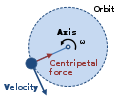 Centripetal force diagram
 -
 Weightless hair
 -
 STS-130 Endeavour flyaround 5
 -
 Clayton Anderson zero g
 -
 Astronauts in weightlessness
 -
 StationLIFE - Cardiovascular (January 2016)


