Refugee: Difference between revisions
CSV import |
CSV import |
||
| Line 39: | Line 39: | ||
{{stub}} | {{stub}} | ||
<gallery> | |||
File:East_German_Guard_-_Flickr_-_The_Central_Intelligence_Agency_(cropped).jpg|East German Guard | |||
File:Darfur_refugee_camp_in_Chad.jpg|Darfur refugee camp in Chad | |||
File:Hercegovački_begunci,_Uroš_Predić.jpg|Hercegovački begunci, Uroš Predić | |||
File:Turkish_refugees_from_Edirne.jpg|Turkish refugees from Edirne | |||
File:Armenian_woman_and_her_children_from_Geghi,_1899.jpg|Armenian woman and her children from Geghi, 1899 | |||
File:Spanish_War_Children001.jpg|Spanish War Children | |||
File:Czech_refugees_from_the_Sudetenland_1.gif|Czech refugees from the Sudetenland | |||
File:Polish_child_refugees_and_war_orphans_in_India_1941.jpg|Polish child refugees and war orphans in India 1941 | |||
File:Bundesarchiv_Bild_183-J19568,_Bei_Stalingrad,_russische_Flüchtlinge.jpg|Bei Stalingrad, russische Flüchtlinge | |||
File:Teheran,_Iran._Polish_woman_and_her_grandchildren_shown_in_an_American_Red_Cross_evacuation_camp_as_they_await_evacuation_to_new_homes.jpeg|Polish woman and her grandchildren in an American Red Cross evacuation camp | |||
File:A_Dutch_school_teacher_leads_a_group_of_refugee_children_just_disembarked_from_a_ship_at_Tilbury_Docks_in_Essex_during_1945._D24064.jpg|A Dutch school teacher leads a group of refugee children at Tilbury Docks in Essex during 1945 | |||
File:Bundesarchiv_Bild_175-S00-00326,_Flüchtlinge_aus_Ostpreußen_auf_Pferdewagen.jpg|Flüchtlinge aus Ostpreußen auf Pferdewagen | |||
</gallery> | |||
Latest revision as of 21:21, 23 February 2025
Refugee
A refugee is a person who has been forced to leave their country in order to escape war, persecution, or natural disaster. The term refugee is often used in the context of international law, specifically the 1951 Refugee Convention, which defines a refugee as a person who is outside their country of nationality or habitual residence, has a well-founded fear of persecution because of their race, religion, nationality, membership of a particular social group or political opinion, and is unable or unwilling to avail themselves of the protection of that country, or to return there, for fear of persecution.
History[edit]
The concept of a refugee has been present throughout human history, but became codified in international law in the 20th century. The League of Nations first established legal protections for refugees in 1921, and these were later expanded by the United Nations in the 1951 Refugee Convention and the 1967 Protocol.
Causes[edit]
Refugees are often the result of a variety of factors, including war, persecution, and natural disasters. In some cases, people may become refugees as a result of economic hardship or environmental degradation.
Legal status and rights[edit]
Under international law, refugees have a number of rights and protections. These include the right not to be returned to a country where they face serious threats to their life or freedom, the right to work, the right to housing, and the right to education.
Challenges[edit]
Refugees often face a number of challenges, including discrimination, poverty, and difficulty accessing services and resources. They may also face mental health issues as a result of their experiences.
See also[edit]
References[edit]
<references />
External links[edit]
 | |
|---|---|
 |
 |
-
 East German Guard
 -
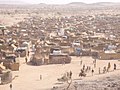 Darfur refugee camp in Chad
 -
 Hercegovački begunci, Uroš Predić
 -
 Turkish refugees from Edirne
 -
 Armenian woman and her children from Geghi, 1899
 -
 Spanish War Children
 -
 Czech refugees from the Sudetenland
 -
 Polish child refugees and war orphans in India 1941
 -
 Bei Stalingrad, russische Flüchtlinge
 -
 Polish woman and her grandchildren in an American Red Cross evacuation camp
 -
 A Dutch school teacher leads a group of refugee children at Tilbury Docks in Essex during 1945
 -
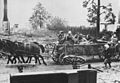 Flüchtlinge aus Ostpreußen auf Pferdewagen
_1.jpg)


